{Of all lies, art is the least untrue - Flaubert}


Thursday, December 25, 2014

3 Films by Altman


For those who like country music, this film might not serve their purpose, although it has several great songs, especially I'm Easy. Those who are interested in politics, this film may look rather glib. For those who want strong characters, they have nothing heroic to see here. Those who believe in free-form, here they go. Underneath the web of huge ensemble cast lies a beautifully free film. Nashville is free from the tight structure, conventional character studies and formal narrative. Nashville is a work of an artist with a camera wandering in Nashville (it may be some other place) and is allowed to film some of the public events and even allowed to flick some private moments. In the song I'm Easy, which is shot in a bar, the song is a public event but the look on faces of all the four enticed women is very personal. That's what Nashville is all about, the relation with celebrity and the public, the connection between stardom and politics, the obsession and the its influence, music and the business, culture and the capital. Altman said once that he views his films as a mural which he need to fill in and the picture that would emerge is even unknown to him beforehand. When different object on the mural with brush and touch, a picture might develop. Nashville, likewise, brings a picture of hopes of people, their dreams and crossed lives caught in propaganda, venal promises and intentions, an mosaic of minuscule images but pointing to something universal. The first song, Keep A'Goin, which is also performed in the last act turns into to a classic irony of the hopes amidst the confused state of affairs that Altman is trying to point out.
Trailer of the film here.

Gosford Park


The setting of the film might not be what Altman would have liked a lot (consider this setting vs the ensemble cast of Nashville and Shortcuts). There are clear demarcations and a very thin/formal interaction between the two classes, one upstairs and the other downstairs. But what must have intrigued Altman is the tension in both the halves, and the subtle similarities and differences between and within the both sides. Altman, master of deftly handling huge casts, must have wondered how the hell to deal with the English upper cast, in all their flair and whims (One of my friends says that he is in love English culture and etiquette, I think he should immediately see this film and if he still want to hold the wine glass in some pre-conceived Anglo-way, I must request Maggie Smith's remarkably vicious Constance Trentham to help him take a tour). As usual, the British cast is excellent both up and down the stairs. To ruthlessly enumerate plot points of the film, its a gathering for a shooting party, a murder and its investigation. The part beauty of the film lies in its satire of these events, flooded with witty dialogues and mannerisms. Given, its an Altman's film, the characters are not representative, they are quite unique and distinct, not to be - as they say - different, but because they are themselves, and also a part of world they inhibit. If we find glimpse of some stereotypes upstairs, its lot to say about those characters. The other part of beauty comes from what is sand witched between the plot of upper and lower crust, there is something bittersweet and humane embedded. The actions upstairs are so secret, nasty and manipulated that we look up for warmth downstairs, which at the face of it, is absent there too. Busy catering to their masters, and in fact known by their master's name downstairs, they are entrapped in the hierarchy as their masters. The young ones seems uneasy with this, but the old servants have mastered the art of servitude. Replying to "What about your life", a head housemaid quips, "Didn't you hear me? I'm the perfect servant; I have no life". As the film progresses, a bundle of secrets unfolds, we see a warmth seeping downstairs, while the upstairs is too busy being a bitch. Towards the end of the film, there is an amazing little scene between two old sisters, and such scenes are for actors (In recent films, other such scene that comes to my mind is from Kinsey done amazingly by Lynn Redgrave, she even says "Prof. Kinsey, You saved my life" and every word of it sounds true), no director can rescue them, if actors don't spark. Two amazing British actresses (Helen Mirren and Eileen Atkins), pull up such a restrained melodrama that it fills the screen with some sort of catharsis.
3 Women

Its a tale of 3 women as the title suggests, here goes what we can understand. Pinky (Sissy Spacek) wants to be what she thinks Millie (Shelley Duvall) is and she thinks that Millie is what Millie wants to be, but Millie is not what she wants to be, she wants to be someone from the women magazines, which she reads. Millie utterly fails but Pinky pulls it up in what they both want to be. Millie and Pinky live in same apartment and work in same resort and in fact have same names. Millie is near perfect in her attires and according to her, known for her dinner parties. Apart from these two women, there is one more, Willie (Janice Rule), who paints weird murals, is pregnant, and has beautiful dark eyes. Enigmatic part includes the skirt of Shelley Duvall which never fits in her yellow car, her Mrs. Dalloway-type ill-fated parties, look on her face when she sees parents of Pinky make love when their daughter lies in coma, the eerie twins at resort, the murals which Willie paints, the birth of a dead boy and that eldritch dream sequence. The way Millie walks around people has that die-hard mix of confidence, caring and caution, that is needed to be a good social-bee. The reason why she is not observing that no one listens to her or takes notice, does it bother her or she go on and on with her recital of recipes and that spooky 'Hi Tom' greetings to Tom, who is ever-coughing, just to avoid going out with her. May be, Millie is a dead person but not aware of it. The infatuation of Pinky with Millie ! She admires her perfection to P. Does she ever notice or take seriously, the indifference that other people show towards Millie or the way Millie go about talking to them fascinates her, the way she is trying hard to dis-alienate. Why is Willie painting those naked bodies, where oracular female form is tortured by the male form. Does her philanderer husband symbolise that cave-male, male from cowboy movie shooting his guns. Why does Willie puncture her ghostly painting with bullets and why no one ever talks to her and she to no one. Several such things occur repeated in the film just like a dream, and its a spiral of all-too-fast unexplained events, that the sleeper wants to get out from, just like a dream.


Unlike other filmmakers, Altman try to give an explanation of it all this mixing of identities and roles, but that does not look to be the point. The point is somewhere between what is perceivable and puzzling. Its is more than tempting to start defining films myriad symbols, but such temptations are fruitless and vain, they are more on the lines of what I understood than what the director wanted to do. Males in this film are either horny (Willie's husband), or indifferent (Pinkie's father) or Dead (Willie's son and possibly Willie's husband too), its a misandrist's dream come true, but Altman doesn't leave his women scotfree, they are shallow and obsessed and engaged in power plays, but at any given point, they are either more human or more interesting then their male counterparts.

Friday, November 14, 2014

The Boss Of It All


Most of the problems in the world arise due to the fact that everyone likes to be loved even if they are more or less horrible people, and everyone has his unique definition what it means to be loved. If we translate this to a corporate guy, his definition of being loved may well be the straightest one. He wants to be loved and held in high esteem and integrity even if he has to pose what he is not, which comes very close to the definition of being loved by a normal person too, just that a corporate person is bound to a corporation, and in a way detached to what he does. The basic problem that all of these smiling, smart and sophisticated corporate people face is to manage and rule and at the same get the love of their subject, make them feel cared when they are being used. We have faced and we have used the big management D, the deference, which in this case means the deference of the responsibility of anything bad to someone else. The only glitch in that is, eventually it goes to a physical person, and that person may not get the love, may not be in the pool of the loved ones, and in that case will be unhappy corporate boss, which is not at all an admirable situation. There is heaps of self-help for both the loved ones and the lovers in the corporate world, but eventually the loss of innocence of the lovers happen and they all get the bitter truth about the loved ones (as you can see we are here taking a sort of ideal situation, the sycophant-gene is altogether neglected, but that can be neglected as its always good for the boss, which is our main concern here). There should be a better solution; there should be a better and easy world for our bosses. The Boss of it all gives that fine solution.

The owner of a Danish IT firm, Ravn, has that terrific idea. He hires a failed actor Kristoffer to pose as a made-up "boss of it all", and makes him responsible for making all the sensitive decision of the company and finally the decision of selling the company to an anti-Dane Icelaner and firing all of the six company's founding members except Ravn. But this foolproof plan has a small but basic problem, the problem that hired actor also wants to be loved. For an actor, the act of getting love is to please by his performance, to get the attention, for a director, it is a approval that someone got jolt and kick by seeing his stuff, which makes him feel something, something similar to being loved. What can be more dangerous than an artist who wants to be loved?

Like other films by Lars von Trier, this film is also an irony, and he spares none (von Trier believes that a film should be like a stone in your shoe :)), just that this time the mood is lighter, the camera is more playful, there is more air to breathe. This breezy irony, plays with the intentions of viewers, as if director is improvising against it, and a comic voice over always keeps things in a light mood and its director's simple way to say that its just a film, and that too a comedy, a irrational one. Film in its goofy irrationality and absurd setting, also examines the relation between the actors, directors, camera and the related ethics. Like the philosophical fool of Dogville, the actor in this film is also director’s doppelganger in particular, and artists and intellectuals in general. As a good satire is only on oneself (otherwise its bitching or criticism, and that is why Altman's The Player is an excellent satire), a good comedy becomes true only if the better jokes are reserved for oneself. Film’s end in which an actor shows what he is good at, is a potent joke on the creative urge and the related admiration that might follow from the performance, because whether it is a corporate cow or a creative crow, its all about being loved.

Tuesday, November 11, 2014

Ordet


As we all know that there is a thin line between a great excellent film and a masterpiece. The thin line is that is transcendence, to use a cliché. It’s the line where the images coerce themselves into one whole and go beyond. We feel free. A film that makes us feel free is itself utterly independent and fearless, of the people who want to kill it with the censorship of the so called profane, or to neglect and ridicule the so called trivial and also those who want to limit it to the worship of so-called good, moral and "useful".

Ordet is so fiercely austere and heart rending. Not a film has moved so much as this one in long time, both emotionally and intellectually. The impact of few films is so deep and elemental that writing about them becomes a clumsy clichéd exercise. This film does not particularly try to express the human condition and expand the human conscious, the prime theme of the film is faith, but it’s not the half-boiled, half hearted faith, but a mad magical love. Since here, even faith has true passion, the things which we might have thought to be slight and stupid, become both lifelike and magical. I, myself, have wondered the way people "use" faith, as one of the way, not "the" way, which defies the very notion of it in spirit. We all have seen, and we all have been, sometime or the other, fearful of faith, but still use it as and when required (As the film patriarch Morten Borgen puts it "But I prayed only because it was worth trying.").

Ordet is a story of Morten Borgen, owner of Borgen farm, and his family of three sons, Johannes, Mikkel and Anders, and Mikkel's wife Inger. They are all dealing with their faiths. The link between them is Inger, who keeps the house alive. The film starts with the scene where each of the family member go out to search for Johannes, who has again ran out from home, thinking he is Jesus. Johannes, who according to Mikkel has gone mad not because of love, but because of Soren Kierkegaard, enters the leaves the frame like the wavering faith of the characters. The way he speaks is prophetic and terrifying. The most terrifying of all is the scene where Johannes sees the beam of headlights of departing car and envisions the death. It is also very excellent use of lighting as a thematic element. Mikkel has lost his faith totally, but according to Inger, he has faith because he is good at heart. Morten, played wonderfully with a mix of old snobbishness and aged wisdom by Henrik Malberg, is also having problem with faith, especially because his prayers for Johannes are going unanswered. Anders is in trouble because he is in love with the daughter of the tailor, who has a different faith.

The main difference between Ordet and films of Bergman, especially Winter Light, with which is frequently compared is essentially the difference between the one still looking for any possibility of faith (faith in faith) and the one who has looked and found nothing, and how to come in terms with it. Actually, it quite unfair to compare the two, in spite of the common theme, because although they seem to be on same continuous line, but it requires a "leap of faith" or a "retract to reason" to jump between the two. Ordet is exemplary in its refusal to reason and rationality because it doesn’t look premeditated. One more film, Ordet is often compared to, is Breaking the Waves, primarily due to its final sequence, but to me Breaking the Waves tryst with faith is like an ironical kiss, but in Dreyer's Ordet, it is a full carnal affair. [Spoilers Ahead] In one of the most striking end scenes ever, as Inger wakes up and passionately kisses Mikkel, we can see the line of Inger's saliva that sticks out from Mikkel's cheek, gloriously celebrating the bodily resurrection along with the soul, and hence when Inger speaks “Life.. Life”, it’s a sensual feeling, not particularly a spiritual one. [Spoilers End]

Dreyer's film is as much about the nature of and our relation with faith, as it is about the limitations of rationality. The vision of Dreyer, as it comes of the film is neither of a cynical nor of a devout. The film, in the end does comfort, but that comfort owes the great burden, the burden of pure and unflinching faith.

Monday, November 03, 2014

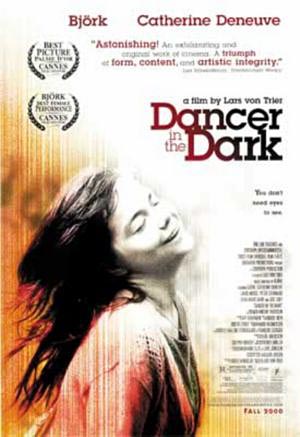
Dancer in the Dark.


Last night, I saw Lars von Trier's Dancer in the Dark. I am still confused which one I liked better, this or Breaking the Waves, I will see Breaking the Waves again soon. Dancer in the Dark has some very sublime moments. Its more emotional but less depressing than Breaking the Waves. I plan to write about it later in detail. For now see this video of the song titled 'I've seen it all' by recording star Björk, who stars as all-good Selma in the film, which is the part of the von Trier trilogy where the heroine remains innocent and saintly despite her actions.

In the DVD, we got to see two more versions of this song, one with longer cuts and the other one with very rapid cuts (especially towards the end). For me long shots work better. Also, this song is filmed using 100 cameras which are fixed at different spots and with few handheld cameras for close-ups and the quality of the later being better than the 100 digicams, was digitally distorted to match with that of digicam's. Lars von Trier talks in a documentary called '100 Cameras' that this experiment didn't work as they expected and explains why. Although this is not the best song of the movie in my opinion, but the most popular one and available online. I liked the 'next to last' song better, I need to see the film few more times to settle on my favorite though. I longed and longed for a song on 'Mum's the word', an idea which is so pivotal to the film as the basic motif of faith and goodness.

Wednesday, October 08, 2014

Titicut Follies


I read in a brief essay on John Houston's The Misfits by J.M. Coetzee , that the amazing thing about films is that the images that you see on screen actually existed in some time and space. He talks this not entirely from the perspective of actors who hold hands, kissed and sat together, but more from the perspective of horses who were supposedly ill treated in the film. I think he took horses as an example not because they are more animal than us in our worldview , but because they didn't know they are being filmed and thats why they never acted. Whatever is captured on screen is, nothing but, once-filmed-reality. The point I am trying to reach here is not the morality of such act (if that would be the case, Lars von Trier should be convicted first of all), but the immediacy, truthfulness of such imagery and the knowledge that it really happened at least once, which is at least one thing that the best of literature can't claim. This preciseness of imagery, to some extent, acts both as the power and powerlessness of cinema. And here we get the bifurcating thin line between films and documentary too. In The Misfits Marilyn Monroe was acting in a film but the horses were in a documentary, and thats why their pain looks more real and more harrowing.

Frederick Wiseman's Titicut Follies is a 1967 documentary about the treatment of patients/inmates at Bridgewater State Hospital in Bridgewater, Massachusetts. It was banned in US from 1967-1992 because it violated the patients' rights to privacy. It is widely considered an essential piece of work for its direct cinéma vérité style and the issues it raise.

Titicut Follies opens with a stage performance by inmates of Bridgewater State Hospital, in its stark black and white photography camera moves from one seemingly happy or blank face to other, who are performing some sort of chorus songs with props (Its like sad song sung by some happy or blank faces). The title of the film is taken from the title of this stage show. As it progresses, we meet other inmates of the hospital. We try to find whats wrong with them and invariably find out that they are either too happy or too sad or too talky or too silent by "normal" standards.

In the middle of Titicut Follies, a naked old man dance thumping his feet in his "prison" cell, I felt almost ashamed of watching something that personal, which is not owing to the nudity, but because it has really happened and it is an honest expression of a person's illness. We fear that someone might enjoy it, laugh at it or someone can even generalize this behavior to madness. Titicut Follies treads in such delicate terrain, that raises it moral responsibility. One of the important properties of sincere documentaries is that they don't comment/remark themselves, they show what they saw without rigging the moral fulcrum. Titicut Follies does the same and hence it comes out clean as an honest document, not just any biased or illiterate humanistic propaganda.

Titicut Follies is not recommended to all (If you wish to ignore, read its tagline first!), many a times in this documentary, one involuntarily takes his eyes off the screen, and even start questioning about its awkwardness, but the strongest point that Titicut Follies raises is the nature of mental illness (one patient, who was supposedly suffering from paranoid schizophrenia and was asking for his release, was so logically persuasive and questioning that you feel jarred) and even more importantly the nature of such institutions, even though it doesn't portray such institution in any bad made-up light. They are doing their job (which in some ways inherently includes indifference, gentle ragging and bullying/forcing too [there is a scene where an inmate is force-fed, this scene is inter-cut with the scenes where other inmate is laid out for burial and we feel some comfort while watching the later]), there are no evil, sadistic wardens. We know, Wiseman is honest enough to show the better and lets you ask for yourself, is it any good.

Thursday, September 11, 2014

Godard's Weekend


In fact, after watching Contempt, I thought of Godard as an academic film maker, not a film maker of ideas. Contempt remains one of the most bizarre films that I watched last year, if we look at the cinematic style, which is not brilliant because it makes a style of its own, as several fine films do, but it breaks down the conventions of film making which we usually accept as rules, thus helping us to see film making in parts, as a brick work of those raw materials. Contempt breaks several existing rules in the book and it tells us that there is no limit to creativity and visual imagination - the imagination in mixing the moving images, the sound and the ideas and the worldviews. Contempt has all what one will expect from a film maker who is known to break into and jump over fences. But Contempt should not be Godard's introductory film, as it was in my case. Its like an infant meets enfant terrible. Kid cries and listens to commentary track. I think what Contempt lacks is the flow of ideas. Although there is Brecht peeking in every frame but that alienation is not used to give us thoughts which Brecht talked about. Contempt has all the masters tricks but does not have much use apart from their display. The commentary track tells us about all those esoteric references and all those rules that are broken in front of our eyes but a normal viewer will think why they are broken, where is that greater good that is achieved by breaking them. I am undoubtedly confused when I saw Contempt. And yesterday that doubt is cleared when I saw Weekend, a film by Jean-Luc Godard.


A couple makes a mysterious plan to inherit the money from their parents and they leave their home to accomplish the mission. After some time, the questions like whether they will succeed and who will get the money (The couple even plots to murder the each other after getting the money and each of them have lovers, they are all in all bad people, but they are not some one off case, they are caricature, metaphorical and representative) and the whole narrative thrust of "what will happen next" becomes so insignificant that only the couple thinks about it but the film takes it own course. Its funny to see film not going where the main characters will like it to go. The film is denying them any heroic or anti-heroic significance. There is not much to talk about what happens in this film, but there is lot to talk about how it happens and how the expectations of the viewers are crushed again and again, and what he gets is, as one early inter-title says, a film adrift in cosmos. It may look as if different parts of this film are scattered but as the film progresses, it takes a shape of ideas that the film wants to convey. Distancing the viewer from what is shown on screen to what director wants to say. The film is polemic and very direct in that way. We hear monologues on Marxism and Maoism (which is criticised by some critics as didactic and over the top), and we hear French revolutionary Saint, narrate us the ideas of liberty.

In a delicate episode, a piano player remarks something that is so profound. He says about Mozart, "Mozart is too easy for beginners and children, too difficult for virtuoso". These types of episodes are particularly dear in the way they are crafted, free and without any text book format, camera pans leisurely to show people standing and sitting as the piano man plays Mozart, the way it is placed next to the car-chaos of cities and highways. Mozart music relates to the serenity of the place. The look on the faces of the village people listening to music and the couple, as insensible as they are shown, could not care less and look immensely bored by it. They want to move on, and the director wants to show another such episode. Beautiful conflict, that Godard uses to bring across his idea of industrial imperialism and bourgeoisie sham, to name a few. All those time tested plot tactics of sex, murder and deceit, that Godard show in the beginning, lead us nowhere, and Godard takes us to an absurdist journey hopping into bourgeoisie, Marx, slapstick, satire, literature, philosophy, civilization, class society, music, pop art, parody, politics, activism and cannibalism.


Cinematic conventions are twisted in each frame. The sound and image are almost always incoherent. The background score becomes gloomy, it heightens and it dissolves for apparently no purpose. There are inessential details, like the time, its Saturday - 10 am, another five minutes have past, the kms in the speedometer etc, as if viewer will want to keep track of it. It has the shadows of commercialization everywhere, and cars becoming a big symbol of it. Anything that uses oil and moves is ridiculed by Godard, including humans. The very famous, 8 min tracking shot of a traffic jam shows us a view of Parisian life, blood, dead bodies, animals, daily life conflicts and different sizes of cars. In an accident, a lady screams that she has lost her designer purse, in a very interesting episode, the lead couple burns Emily Brontë because she is not giving answer to their question, in the same scene, Brontë asks them GMAT type questions. The discussion between a young rich girl and a tractor driver is directly out of Communist manifesto's first chapter, the Bourgeoisie and the Proletarian. Towards the end, the hilarious orgy which was narrated earlier in the film (see the narration of this orgy scene in contrast to that of Bergman's Persona), is actually performed, but in a very unexpected and hellish way, and the film moves from bourgeois houses to countryside to guerrilla jungles and amidst all this chaos, Godard's version the living hell emerges. Unlike Contempt, this film fills those detachment gaps with solid ideas and radical thoughts.

For me, this film became a unique experience. After watching Weekend, I rushed to see Munich, and it is such a contrast in approach, although its unfair to compare both, but you cant help it when you watch them back to back. Weekend looked like a 'View source' of Munich's pretty HTML page, to put it in a slapstick way. I have starting feeling contempt for all those high risk saving scenes (the one where the Arab ambassador's daughter was saved in Munich) after watching Funny Games and Code Unknown (there is similar scene in Code unknown where a toddler is saved while his parents frolic in swimming pool, that scene has an ultimate concoction of sex, skin show, family love, hyped excitement, hope and happy ending). Munich manufactured everything in detail while Weekend deconstructed every detail. Munich used emotions to take its point across and Weekend used mechanical monologues and chaotic imagery. In Munich, every act of violence is regretted with heroic closeups, in Weekend, there is no remorse when the rabbit of Monsieur Flaubert is killed. Before sleeping, I gathered what was Munich all about while traffic cars honked endlessly, a cyclist thrown off pavement by a honking car, car ran down by big truck and so on.


Weekend took a step further in what I thought movies like Code Unknown can do. Code Unknown episodes have reality, they are even emotional. But Weekend, at times, looks unreal, but like a near future of our civilisation - its end, it horrifies and jolts. Weekend is unapologetic in being prophetic. Weekend is meant to irritate and to frustrate, it may look insane to people, it is actually a caustic, mean film, grotesque, as some may say "what the hell is going on". It is all that and more. It is angry and aggressive. Some people will hate it and I think that's what director wanted. Its not easily ignorable, as a bunch of undeniable ideas, as the view of urban hell, and also to know cinema as an art form of infinite possibilities

Sunday, July 27, 2014

Bresson's Mouchette


Q: What's this film all about?
A: It's about a girl, a sad story of a girl.

Q: Did you like the movie?
A: Yes.

Q: What did you like?
A: The whole film.

Q: Anything specific...
A: Yes, there are lots of things I liked. The scene in the carnival bumper car, the one where the girls sing at school, the one where a neighbor offers Mouchette coffee, the one where Mouchette sings for Arsene and many more. Actually, Mouchette's last morning has some very good and incisive episodes.

Q: Why is this girl suffering?
A: No reason is given. It's like everyone suffers.

Q: Has her plight some deeper meaning, the plight of humanity etc.
A: I think so, and thats why it is gloomier than it seems.

Q: Are there some metaphors here.
A: I thought the first shot was a metaphor - the one with the bird and the snare, but later I thought I was wrong.

Q: Are the performances good.
A: They are really good. I liked the mother; she has some God-like presence. She is horrifying at times.

Q: Why do you think so?
A: Actually it's because of the opening lines she says and because she is always ill, not caring or not able to care.

Q: What is the opening line.
A: What will they do without me?

Q: You are again thinking about symbols and metaphors, are you wrong again ?
A: May be.

Q: Is Mouchette an endearing character ?
A: No, she is not. She has some mixture of vulnerability, ferocity and innocence. She shows some gestures of compassion, but she is not endearing. And that has lot to say about our narrow definition of being endearing.

Q: Is she pitiful.
A: Yes, I think so.

Q: Is she human.
A: Definitely.

Q: What do you think of the rape scene?
A: It was very meticulously done. The way Mouchette puts her hand on the rapist's shoulder is particularly heart breaking. I liked the scenes preceding the rape scene very much, the way Mouchette starts caring for Arsene.

Q: Did you watch the film alone.
A: Sort of, my friend slept off

Q: What about the last scene
A: Mouchette commits suicide. Its staged as if Bresson is doing rehearsal for the shot.

Q: Why she commits suicide ?
A: I think their can be very personal answers to such questions. Director doesn't give you one. There are two animal sequences in the movie, and if you want to draw some analogies of battle of survival or misery of existence, in which we eventually succumb, you can.

Q: What's your answer for it?
A: I will again resort to metaphors and stuff and I will be wrong again. I think labelling metaphors and symbols reduce the directness of the art. They help at times, but not always.

Q: What do you think is the theme of the film?
A: I think it about suffering and indifference of one person to the suffering of others.

Q: That's a big theme, don't you think you are giving a vague answer.
A: Actually, I think it's about suffering and if we try to associate any big metaphors to it, it will remove the immediacy that this movie has. 'Everyone suffers like Mouchette did' may seem to be the right thing to say but will put the whole effort at a distance and in indifference.

Q: But Bresson himself said "Mouchette offers evidence of misery and cruelty. She is found everywhere: wars, concentration camps, tortures, assassinations."
A: Yes, he said. But Mouchette just becomes a testimonial and evidence, not an image of plight. No one can say that young girls always suffer or orphans always suffer. One can say, there is suffering in the world. Its an acknowledgement of suffering, not its trivialization.

Q: I think you are contradicting yourself .
A: May be.

Q: Is Mouchette doomed by her own actions of hatred.
A: I don't think so. In a potentially happy scene (it reminds me of a scene of Bresson's "Diary of Country Priest" where the young priest go on for a motor bike ride) it is shown that if given the situation/chance Mouchette can really enjoy. She wants to be happy. Her actions are almost immaterial to the surroundings, nobody cares. In a way, her desire to connect to any human being, even a stranger, leads to her rape.

Q: What would have helped Mouchette?
A: What's provided in the film, it seems she is doomed to be unhappy. May be after the motor ride, if she would have talked to the Youngman, she could have found some temporary happiness. But the film is not about Mouchette finding happiness.

Q: I mean, she being good to the people around him. Caring more and stuff.
A: I don't think so.

Q: What good a film is, if it shows just a picture of doom.
A: It shows it exists, and that's its strength. It shows it exists and doesn't give any reason, it shows its universality.

Q: I think you are contradicting some of your previous statements.
A: It's difficult to be consistent. Consistency is overrated.

Q: Will you write about on your blog.
A: I will try, do read it.

Q: Sure. Is there a spiritual current in the film, Bresson is called a Catholic artist.
A: You are again pushing me to contradict myself. I sometime think Bresson want to say that amidst all this selfishness, there is some goodness and that can save the humanity, but we are always brutally raping that goodness, crushing its spirit. And he shows 'Good' suffering like the Christian God, but it ultimately finds grace. I believed this statement more strongly before watching Mouchette.

Q: Tell one cliché you would like to say honestly now.
A: This film is a masterpiece.

Q: Will you recommend the movie.
A: Yes, there is no reason not to. Even if you don't like it, you will think about it.

Q: Your friend slept off in between...
A: Should it matter?

Q: Did you find it depressing
A: It's not depressing but it has a feeling of doom. It seems everyone and everything is going to die, it's like a cold hell.

Q: One last question, do you feel Mouchette is saintly.
A: Yes, the film and the girl, both.

Wednesday, July 16, 2014

The Killing


The Killing, Stanley Kubrick's film noir is about making, execution and failure of a heist plan. No doubt, it is perfectly planned and executed by Kubrick and the also by the bunch of tough guys on screen. But unlike the plan of tough guys, Kubrick succeeds brilliantly in his. It might well be the best of Kubrick's film I have seen (I might be saying this because I have seen it just half an hour ago and still title menu sounds are playing about the seventh race, and also because I found it a small tight film, not like the later opulent ones). What's most interesting thing about the film is its use of precise timing as a very intelligent way that seems to say in way that we are exactly following the film script, like the characters of the film have the tight grip of the plan, so as the director of the movie. At one point it says the we are running 15 minutes late, it generates so much tension as if the worst has come, because somehow we all know that its all going to fall apart, and just waiting for it, holding our breath. Director has taken a close control on character's doomed destinies, but we feel partly fate and partly fiendish femme fatale are responsible for the failure of this precise plan. The outcome of the film is like the line said by a character early in the film, 'This unique system of betting will more than likely result in a loss'.


In the classic case dim husband and prim beauty, George Peatty (Elisha Cook Jr.) tells the secret plan to to his wife, Sherry Peatty (Marie Windsor), who in turn involves her love interest to back stab her husband. The end of the couple is pretty sad in the film and as Sherry remarks, "This is a bad joke without a punch line". But this episode adds the flair of doom in the film, we now know that all can not be happy and we also know that plan can not work out, so we know the inevitability of a lose-lose situation. It, along with other sneaky brief touches of characterization, also points out that the robbery didn't fail because of the flaw in plan, but because human beings were involved in it, so were their desires, dreams and intentions, which both drove and doomed it.

The ending of The Killing is just great. It is not great the way dollars fly in air but how a little doggy runs for them. The last scene is a perfect killing, where no blood flows, its a killing of fiscal dreams. It is brilliant how enervated Johnny Clay (Sterling Hayden, the eccentric Brig. Gen. Jack D. Ripper of Dr. Strangelove) surrenders, saying " Nah, what's the difference". Its the moment he stops dreaming, a moment of no hope.

Thursday, July 10, 2014

Oye Lucky! Lucky Oye!


I missed first 15-20 mins of Oye Lucky! Lucky Oye!. It all started with the trouble to reach the theatre. The listing that I checked showed 66th and 3rd Ave but it was actually 11th and 3rd (it is another story how I figured out that, in short it was not easy). When I reached panting, it was already 3:15 pm for a 2:50 pm show (I hope in the beginning they showed trailers of usual Bollywood crap like Dostana which was playing next door). All the trouble was worth it. I was just sad that I was the only one in the theatre, when the Dostana screen had so many people. No Kidding, it was sad.

Lets start with a customary one liner plotline. Lucky, the charming, (an astonishing Abhay Deol) is a superchor, who along with his childhood friend, Bangali (Manu Rishi), works for Gogi Bhai (Paresh Rawal), but owing to his oversized charm and intelligence, he outsizes Gogi bhai and along the way he finds fame and notoriety, falls in love ["Jugnu rehndi sheeshe paar"] and hopes for a happy family life ["jugni hasdi ve hasdi, ke dil vich basdi"]. In this standard storyline, the first and foremost thing that director Dibakar Banerjee does is to literally add Delhi(same as he did in Khosla ka Ghosla, remember quick rajma recipe ["main kenni rajma chawal chadha de, ke do di vajai chaar citeeyaan vaja de, vich thoda soda paade, kal kenda ni si khada khazana waala"] in the opening scene). So a standard scene of seduction translates to that marvellous scene where the girl says "by god, main touch ho gayi" and a dinning table conversation translates to something even more marvellous [ "yeh show piece hai aur yeh khana"]. What is more amazing is that it all happens without a single stereotype, if I can say so (and I mean it as appeciation), they are all humane caricatures written with lots of sympathy for them. One way to explain this is through one of the song in the film soundtrack "Tu Raja ki Raj Dulari", a soulful Haryanavi Ballad (raagni). With raw traditional voice and lyrics, the song is true its spirit but the techno beat (which never tempers with voice and lyrics) is the indication of the milieu where it is used. Our hero is not someone who will write and sing that song, but the one who feels the same emotion (and may be in the same language) just because of the fact that he has grown listening to such sound and music. It is an excellent way for a film to connect to roots of its characters and fly, never giving an impression that such music is "used" for just creating the impression of Delhi like shots of Chandni Chowk to India Gate are cheaply used as "establishing shots" for Delhi in much of Yashraj-Brand Filmmaking.

Not to put the film in any disadvantage of over-expectation, I think Oye Lucky, Lucky Oye! is even better than Khosla ka Ghosla (although I have see Oye Lucky! at least one more time to say anything concrete), and one aspect where the film clearly exceeds is performances (I think for the kind of films Dibakar Banerjee is making, he knows how important the performances are). I did not find any of the performance weak (I only wish that the triple role of Paresh Rawal can be distributed among more actors just in the hope of finding more of Richa Chaddas and Manu Rishis, also I did not find any reason (logical or illogical, something like Ayeshia Takia playing both wife and secretary to K in No Smoking) why they are played by same actor. May be something happened in first few mins that I missed). Oye Lucky, Lucky Oye ! is a treasure trove of performances. A performance like Richa Chadda's Dolly is great by any standards. It is not a central role but its pivotal in a way any character role can be. It is not by chance that when I gave two examples before of how similar situations are translated to Delhi lingo, I quoted both lines said by Dolly, it is because she gets it perfectly right all the time, little here or there would have made those scenes little funnier but much more dispassionate. If Neetu Chandra's Sonal (excellent by the way) is girl next door, Dolly is definitely girl few doors away, a more cinematic entity, a more vibrant character.

The romance between Sonal and Lucky starts with Lucky's usual charm but the director plays with it for Lucky's need to have a family and with the excellent glass door motif, without overemphasizing, he conveys the fragility of this love, and also the emotional distance between lovers. Every visit and every opening of the glass door is a new beginning for the lovers. In few beautiful shots we see Neetu Chandra standing in front of the glass door, both fearful and waiting to open the door. It looked as if the director touched the cornerstone of romantic love.

I should not forget to note the first rate and large-hearted humor of the film which makes it such an entertaining fare. I was time and again amazed by the clever use of Hindi/Punjabi/Haryanavi (remember the first meeting of Special branch cop with Gogi Bhai and his flip to Haryanavi). And do you remember why Bangali is called Bangali? And how can one forget the "Lady Doggy" sequence - the funniest celebration of canine love. It is so heartening to see that even if director is dealing with something dark at the core, but he never raises "its serious cinema" flag. It is heartening to see someone trust his audience that they will understand the void in Lucky's life amidst the flourishes of his adventures and his zest for life.

A word about music, although I have touched it before. I am a minority of the people whom I know who think that Punjabi language and music has an unparalleled emotional power and much of it is wasted in similar-sounding bhangra beat numbers. I still remember the days when I first heard real Punjabi music in a Spic-macay concert at my college, it was amazed how soul-stirring it was. This film gets its music and the tone right and how songs are used without interrupting the narrative and how the mix of folk and funk is just suited for it.

One way to show the life of Lucky Singh is to realistically portray every twist and turns of his adventures and the other way to mythologize (not idolize) it. I personally like the later approach especially when it is used for something where it should not be used in popular culture, partly because its deviant, risky and interesting, but more so because it rescues the film from the typical struggle between good and evil, inspiration and rebuke but puts its in the realms of storytelling and about the passion of the protagonist. I felt that Lucky does not have passion for stealing (although to his credit he never differentiated between big and small, stealing everything with equal love) but a skill for it. His passion was his aspirations (if he were good at anything else, he will use it to pursue his aspirations) which the director beautifully uses to reveal different aspects of society which he interacts with. To the distant, he is a notorious celebrity of India's Most wanted list, and for the near, he is much more complex, evoking awe, love, hate and envy at equal measure, to us film goers he is sort of a middle class myth and director does something in the last shot of the film [a pixelled black and white close-up of Lucky] which comes close to mythologizing him.

To tell the truth, I was little scared before I saw the film. It is usual scare a cinephile experiences when he goes to see the second film of a director whose first film was really good. It was the similar scare which I had when I saw No Smoking, and it will be the same when I will see the next film by Navdeep Singh. It is more than the feeling that the director may screw it (he has all the freedom to screw) but it is a feeling that what ever you so dearly liked about the film was something of a byproduct (may be a fluke) not director's main concern, he does not think the way you thought he does. A second good film reassures all that. Oye Lucky! Lucky Oye! does that.