{Of all lies, art is the least untrue - Flaubert}


Monday, November 03, 2014

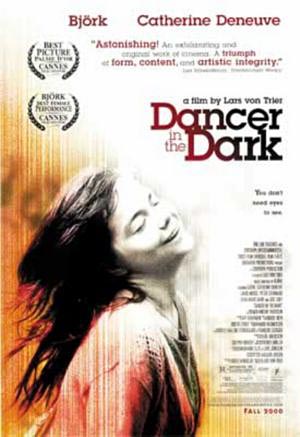
Dancer in the Dark.


Last night, I saw Lars von Trier's Dancer in the Dark. I am still confused which one I liked better, this or Breaking the Waves, I will see Breaking the Waves again soon. Dancer in the Dark has some very sublime moments. Its more emotional but less depressing than Breaking the Waves. I plan to write about it later in detail. For now see this video of the song titled 'I've seen it all' by recording star Björk, who stars as all-good Selma in the film, which is the part of the von Trier trilogy where the heroine remains innocent and saintly despite her actions.

In the DVD, we got to see two more versions of this song, one with longer cuts and the other one with very rapid cuts (especially towards the end). For me long shots work better. Also, this song is filmed using 100 cameras which are fixed at different spots and with few handheld cameras for close-ups and the quality of the later being better than the 100 digicams, was digitally distorted to match with that of digicam's. Lars von Trier talks in a documentary called '100 Cameras' that this experiment didn't work as they expected and explains why. Although this is not the best song of the movie in my opinion, but the most popular one and available online. I liked the 'next to last' song better, I need to see the film few more times to settle on my favorite though. I longed and longed for a song on 'Mum's the word', an idea which is so pivotal to the film as the basic motif of faith and goodness.

Wednesday, October 08, 2014

Titicut Follies


I read in a brief essay on John Houston's The Misfits by J.M. Coetzee , that the amazing thing about films is that the images that you see on screen actually existed in some time and space. He talks this not entirely from the perspective of actors who hold hands, kissed and sat together, but more from the perspective of horses who were supposedly ill treated in the film. I think he took horses as an example not because they are more animal than us in our worldview , but because they didn't know they are being filmed and thats why they never acted. Whatever is captured on screen is, nothing but, once-filmed-reality. The point I am trying to reach here is not the morality of such act (if that would be the case, Lars von Trier should be convicted first of all), but the immediacy, truthfulness of such imagery and the knowledge that it really happened at least once, which is at least one thing that the best of literature can't claim. This preciseness of imagery, to some extent, acts both as the power and powerlessness of cinema. And here we get the bifurcating thin line between films and documentary too. In The Misfits Marilyn Monroe was acting in a film but the horses were in a documentary, and thats why their pain looks more real and more harrowing.

Frederick Wiseman's Titicut Follies is a 1967 documentary about the treatment of patients/inmates at Bridgewater State Hospital in Bridgewater, Massachusetts. It was banned in US from 1967-1992 because it violated the patients' rights to privacy. It is widely considered an essential piece of work for its direct cinéma vérité style and the issues it raise.

Titicut Follies opens with a stage performance by inmates of Bridgewater State Hospital, in its stark black and white photography camera moves from one seemingly happy or blank face to other, who are performing some sort of chorus songs with props (Its like sad song sung by some happy or blank faces). The title of the film is taken from the title of this stage show. As it progresses, we meet other inmates of the hospital. We try to find whats wrong with them and invariably find out that they are either too happy or too sad or too talky or too silent by "normal" standards.

In the middle of Titicut Follies, a naked old man dance thumping his feet in his "prison" cell, I felt almost ashamed of watching something that personal, which is not owing to the nudity, but because it has really happened and it is an honest expression of a person's illness. We fear that someone might enjoy it, laugh at it or someone can even generalize this behavior to madness. Titicut Follies treads in such delicate terrain, that raises it moral responsibility. One of the important properties of sincere documentaries is that they don't comment/remark themselves, they show what they saw without rigging the moral fulcrum. Titicut Follies does the same and hence it comes out clean as an honest document, not just any biased or illiterate humanistic propaganda.

Titicut Follies is not recommended to all (If you wish to ignore, read its tagline first!), many a times in this documentary, one involuntarily takes his eyes off the screen, and even start questioning about its awkwardness, but the strongest point that Titicut Follies raises is the nature of mental illness (one patient, who was supposedly suffering from paranoid schizophrenia and was asking for his release, was so logically persuasive and questioning that you feel jarred) and even more importantly the nature of such institutions, even though it doesn't portray such institution in any bad made-up light. They are doing their job (which in some ways inherently includes indifference, gentle ragging and bullying/forcing too [there is a scene where an inmate is force-fed, this scene is inter-cut with the scenes where other inmate is laid out for burial and we feel some comfort while watching the later]), there are no evil, sadistic wardens. We know, Wiseman is honest enough to show the better and lets you ask for yourself, is it any good.

Thursday, September 11, 2014

Godard's Weekend


In fact, after watching Contempt, I thought of Godard as an academic film maker, not a film maker of ideas. Contempt remains one of the most bizarre films that I watched last year, if we look at the cinematic style, which is not brilliant because it makes a style of its own, as several fine films do, but it breaks down the conventions of film making which we usually accept as rules, thus helping us to see film making in parts, as a brick work of those raw materials. Contempt breaks several existing rules in the book and it tells us that there is no limit to creativity and visual imagination - the imagination in mixing the moving images, the sound and the ideas and the worldviews. Contempt has all what one will expect from a film maker who is known to break into and jump over fences. But Contempt should not be Godard's introductory film, as it was in my case. Its like an infant meets enfant terrible. Kid cries and listens to commentary track. I think what Contempt lacks is the flow of ideas. Although there is Brecht peeking in every frame but that alienation is not used to give us thoughts which Brecht talked about. Contempt has all the masters tricks but does not have much use apart from their display. The commentary track tells us about all those esoteric references and all those rules that are broken in front of our eyes but a normal viewer will think why they are broken, where is that greater good that is achieved by breaking them. I am undoubtedly confused when I saw Contempt. And yesterday that doubt is cleared when I saw Weekend, a film by Jean-Luc Godard.


A couple makes a mysterious plan to inherit the money from their parents and they leave their home to accomplish the mission. After some time, the questions like whether they will succeed and who will get the money (The couple even plots to murder the each other after getting the money and each of them have lovers, they are all in all bad people, but they are not some one off case, they are caricature, metaphorical and representative) and the whole narrative thrust of "what will happen next" becomes so insignificant that only the couple thinks about it but the film takes it own course. Its funny to see film not going where the main characters will like it to go. The film is denying them any heroic or anti-heroic significance. There is not much to talk about what happens in this film, but there is lot to talk about how it happens and how the expectations of the viewers are crushed again and again, and what he gets is, as one early inter-title says, a film adrift in cosmos. It may look as if different parts of this film are scattered but as the film progresses, it takes a shape of ideas that the film wants to convey. Distancing the viewer from what is shown on screen to what director wants to say. The film is polemic and very direct in that way. We hear monologues on Marxism and Maoism (which is criticised by some critics as didactic and over the top), and we hear French revolutionary Saint, narrate us the ideas of liberty.

In a delicate episode, a piano player remarks something that is so profound. He says about Mozart, "Mozart is too easy for beginners and children, too difficult for virtuoso". These types of episodes are particularly dear in the way they are crafted, free and without any text book format, camera pans leisurely to show people standing and sitting as the piano man plays Mozart, the way it is placed next to the car-chaos of cities and highways. Mozart music relates to the serenity of the place. The look on the faces of the village people listening to music and the couple, as insensible as they are shown, could not care less and look immensely bored by it. They want to move on, and the director wants to show another such episode. Beautiful conflict, that Godard uses to bring across his idea of industrial imperialism and bourgeoisie sham, to name a few. All those time tested plot tactics of sex, murder and deceit, that Godard show in the beginning, lead us nowhere, and Godard takes us to an absurdist journey hopping into bourgeoisie, Marx, slapstick, satire, literature, philosophy, civilization, class society, music, pop art, parody, politics, activism and cannibalism.


Cinematic conventions are twisted in each frame. The sound and image are almost always incoherent. The background score becomes gloomy, it heightens and it dissolves for apparently no purpose. There are inessential details, like the time, its Saturday - 10 am, another five minutes have past, the kms in the speedometer etc, as if viewer will want to keep track of it. It has the shadows of commercialization everywhere, and cars becoming a big symbol of it. Anything that uses oil and moves is ridiculed by Godard, including humans. The very famous, 8 min tracking shot of a traffic jam shows us a view of Parisian life, blood, dead bodies, animals, daily life conflicts and different sizes of cars. In an accident, a lady screams that she has lost her designer purse, in a very interesting episode, the lead couple burns Emily Brontë because she is not giving answer to their question, in the same scene, Brontë asks them GMAT type questions. The discussion between a young rich girl and a tractor driver is directly out of Communist manifesto's first chapter, the Bourgeoisie and the Proletarian. Towards the end, the hilarious orgy which was narrated earlier in the film (see the narration of this orgy scene in contrast to that of Bergman's Persona), is actually performed, but in a very unexpected and hellish way, and the film moves from bourgeois houses to countryside to guerrilla jungles and amidst all this chaos, Godard's version the living hell emerges. Unlike Contempt, this film fills those detachment gaps with solid ideas and radical thoughts.

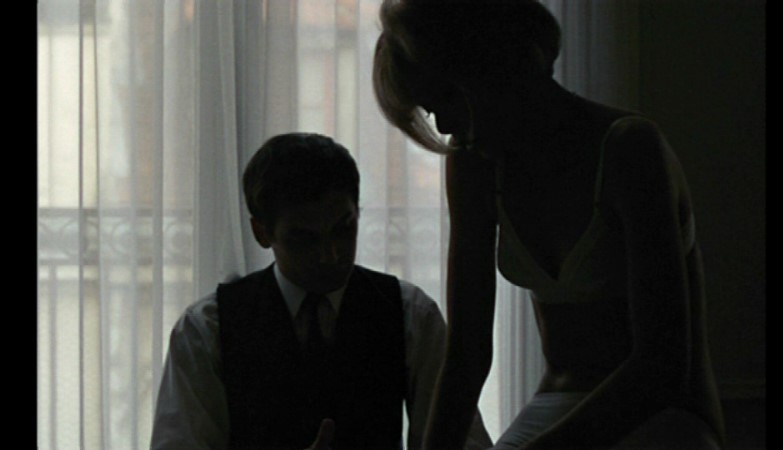
For me, this film became a unique experience. After watching Weekend, I rushed to see Munich, and it is such a contrast in approach, although its unfair to compare both, but you cant help it when you watch them back to back. Weekend looked like a 'View source' of Munich's pretty HTML page, to put it in a slapstick way. I have starting feeling contempt for all those high risk saving scenes (the one where the Arab ambassador's daughter was saved in Munich) after watching Funny Games and Code Unknown (there is similar scene in Code unknown where a toddler is saved while his parents frolic in swimming pool, that scene has an ultimate concoction of sex, skin show, family love, hyped excitement, hope and happy ending). Munich manufactured everything in detail while Weekend deconstructed every detail. Munich used emotions to take its point across and Weekend used mechanical monologues and chaotic imagery. In Munich, every act of violence is regretted with heroic closeups, in Weekend, there is no remorse when the rabbit of Monsieur Flaubert is killed. Before sleeping, I gathered what was Munich all about while traffic cars honked endlessly, a cyclist thrown off pavement by a honking car, car ran down by big truck and so on.


Weekend took a step further in what I thought movies like Code Unknown can do. Code Unknown episodes have reality, they are even emotional. But Weekend, at times, looks unreal, but like a near future of our civilisation - its end, it horrifies and jolts. Weekend is unapologetic in being prophetic. Weekend is meant to irritate and to frustrate, it may look insane to people, it is actually a caustic, mean film, grotesque, as some may say "what the hell is going on". It is all that and more. It is angry and aggressive. Some people will hate it and I think that's what director wanted. Its not easily ignorable, as a bunch of undeniable ideas, as the view of urban hell, and also to know cinema as an art form of infinite possibilities

Sunday, July 27, 2014

Bresson's Mouchette


Q: What's this film all about?
A: It's about a girl, a sad story of a girl.

Q: Did you like the movie?
A: Yes.

Q: What did you like?
A: The whole film.

Q: Anything specific...
A: Yes, there are lots of things I liked. The scene in the carnival bumper car, the one where the girls sing at school, the one where a neighbor offers Mouchette coffee, the one where Mouchette sings for Arsene and many more. Actually, Mouchette's last morning has some very good and incisive episodes.

Q: Why is this girl suffering?
A: No reason is given. It's like everyone suffers.

Q: Has her plight some deeper meaning, the plight of humanity etc.
A: I think so, and thats why it is gloomier than it seems.

Q: Are there some metaphors here.
A: I thought the first shot was a metaphor - the one with the bird and the snare, but later I thought I was wrong.

Q: Are the performances good.
A: They are really good. I liked the mother; she has some God-like presence. She is horrifying at times.

Q: Why do you think so?
A: Actually it's because of the opening lines she says and because she is always ill, not caring or not able to care.

Q: What is the opening line.
A: What will they do without me?

Q: You are again thinking about symbols and metaphors, are you wrong again ?
A: May be.

Q: Is Mouchette an endearing character ?
A: No, she is not. She has some mixture of vulnerability, ferocity and innocence. She shows some gestures of compassion, but she is not endearing. And that has lot to say about our narrow definition of being endearing.

Q: Is she pitiful.
A: Yes, I think so.

Q: Is she human.
A: Definitely.

Q: What do you think of the rape scene?
A: It was very meticulously done. The way Mouchette puts her hand on the rapist's shoulder is particularly heart breaking. I liked the scenes preceding the rape scene very much, the way Mouchette starts caring for Arsene.

Q: Did you watch the film alone.
A: Sort of, my friend slept off

Q: What about the last scene
A: Mouchette commits suicide. Its staged as if Bresson is doing rehearsal for the shot.

Q: Why she commits suicide ?
A: I think their can be very personal answers to such questions. Director doesn't give you one. There are two animal sequences in the movie, and if you want to draw some analogies of battle of survival or misery of existence, in which we eventually succumb, you can.

Q: What's your answer for it?
A: I will again resort to metaphors and stuff and I will be wrong again. I think labelling metaphors and symbols reduce the directness of the art. They help at times, but not always.

Q: What do you think is the theme of the film?
A: I think it about suffering and indifference of one person to the suffering of others.

Q: That's a big theme, don't you think you are giving a vague answer.
A: Actually, I think it's about suffering and if we try to associate any big metaphors to it, it will remove the immediacy that this movie has. 'Everyone suffers like Mouchette did' may seem to be the right thing to say but will put the whole effort at a distance and in indifference.

Q: But Bresson himself said "Mouchette offers evidence of misery and cruelty. She is found everywhere: wars, concentration camps, tortures, assassinations."
A: Yes, he said. But Mouchette just becomes a testimonial and evidence, not an image of plight. No one can say that young girls always suffer or orphans always suffer. One can say, there is suffering in the world. Its an acknowledgement of suffering, not its trivialization.

Q: I think you are contradicting yourself .
A: May be.

Q: Is Mouchette doomed by her own actions of hatred.
A: I don't think so. In a potentially happy scene (it reminds me of a scene of Bresson's "Diary of Country Priest" where the young priest go on for a motor bike ride) it is shown that if given the situation/chance Mouchette can really enjoy. She wants to be happy. Her actions are almost immaterial to the surroundings, nobody cares. In a way, her desire to connect to any human being, even a stranger, leads to her rape.

Q: What would have helped Mouchette?
A: What's provided in the film, it seems she is doomed to be unhappy. May be after the motor ride, if she would have talked to the Youngman, she could have found some temporary happiness. But the film is not about Mouchette finding happiness.

Q: I mean, she being good to the people around him. Caring more and stuff.
A: I don't think so.

Q: What good a film is, if it shows just a picture of doom.
A: It shows it exists, and that's its strength. It shows it exists and doesn't give any reason, it shows its universality.

Q: I think you are contradicting some of your previous statements.
A: It's difficult to be consistent. Consistency is overrated.

Q: Will you write about on your blog.
A: I will try, do read it.

Q: Sure. Is there a spiritual current in the film, Bresson is called a Catholic artist.
A: You are again pushing me to contradict myself. I sometime think Bresson want to say that amidst all this selfishness, there is some goodness and that can save the humanity, but we are always brutally raping that goodness, crushing its spirit. And he shows 'Good' suffering like the Christian God, but it ultimately finds grace. I believed this statement more strongly before watching Mouchette.

Q: Tell one cliché you would like to say honestly now.
A: This film is a masterpiece.

Q: Will you recommend the movie.
A: Yes, there is no reason not to. Even if you don't like it, you will think about it.

Q: Your friend slept off in between...
A: Should it matter?

Q: Did you find it depressing
A: It's not depressing but it has a feeling of doom. It seems everyone and everything is going to die, it's like a cold hell.

Q: One last question, do you feel Mouchette is saintly.
A: Yes, the film and the girl, both.

Wednesday, July 16, 2014

The Killing


The Killing, Stanley Kubrick's film noir is about making, execution and failure of a heist plan. No doubt, it is perfectly planned and executed by Kubrick and the also by the bunch of tough guys on screen. But unlike the plan of tough guys, Kubrick succeeds brilliantly in his. It might well be the best of Kubrick's film I have seen (I might be saying this because I have seen it just half an hour ago and still title menu sounds are playing about the seventh race, and also because I found it a small tight film, not like the later opulent ones). What's most interesting thing about the film is its use of precise timing as a very intelligent way that seems to say in way that we are exactly following the film script, like the characters of the film have the tight grip of the plan, so as the director of the movie. At one point it says the we are running 15 minutes late, it generates so much tension as if the worst has come, because somehow we all know that its all going to fall apart, and just waiting for it, holding our breath. Director has taken a close control on character's doomed destinies, but we feel partly fate and partly fiendish femme fatale are responsible for the failure of this precise plan. The outcome of the film is like the line said by a character early in the film, 'This unique system of betting will more than likely result in a loss'.


In the classic case dim husband and prim beauty, George Peatty (Elisha Cook Jr.) tells the secret plan to to his wife, Sherry Peatty (Marie Windsor), who in turn involves her love interest to back stab her husband. The end of the couple is pretty sad in the film and as Sherry remarks, "This is a bad joke without a punch line". But this episode adds the flair of doom in the film, we now know that all can not be happy and we also know that plan can not work out, so we know the inevitability of a lose-lose situation. It, along with other sneaky brief touches of characterization, also points out that the robbery didn't fail because of the flaw in plan, but because human beings were involved in it, so were their desires, dreams and intentions, which both drove and doomed it.

The ending of The Killing is just great. It is not great the way dollars fly in air but how a little doggy runs for them. The last scene is a perfect killing, where no blood flows, its a killing of fiscal dreams. It is brilliant how enervated Johnny Clay (Sterling Hayden, the eccentric Brig. Gen. Jack D. Ripper of Dr. Strangelove) surrenders, saying " Nah, what's the difference". Its the moment he stops dreaming, a moment of no hope.

Thursday, July 10, 2014

Oye Lucky! Lucky Oye!


I missed first 15-20 mins of Oye Lucky! Lucky Oye!. It all started with the trouble to reach the theatre. The listing that I checked showed 66th and 3rd Ave but it was actually 11th and 3rd (it is another story how I figured out that, in short it was not easy). When I reached panting, it was already 3:15 pm for a 2:50 pm show (I hope in the beginning they showed trailers of usual Bollywood crap like Dostana which was playing next door). All the trouble was worth it. I was just sad that I was the only one in the theatre, when the Dostana screen had so many people. No Kidding, it was sad.

Lets start with a customary one liner plotline. Lucky, the charming, (an astonishing Abhay Deol) is a superchor, who along with his childhood friend, Bangali (Manu Rishi), works for Gogi Bhai (Paresh Rawal), but owing to his oversized charm and intelligence, he outsizes Gogi bhai and along the way he finds fame and notoriety, falls in love ["Jugnu rehndi sheeshe paar"] and hopes for a happy family life ["jugni hasdi ve hasdi, ke dil vich basdi"]. In this standard storyline, the first and foremost thing that director Dibakar Banerjee does is to literally add Delhi(same as he did in Khosla ka Ghosla, remember quick rajma recipe ["main kenni rajma chawal chadha de, ke do di vajai chaar citeeyaan vaja de, vich thoda soda paade, kal kenda ni si khada khazana waala"] in the opening scene). So a standard scene of seduction translates to that marvellous scene where the girl says "by god, main touch ho gayi" and a dinning table conversation translates to something even more marvellous [ "yeh show piece hai aur yeh khana"]. What is more amazing is that it all happens without a single stereotype, if I can say so (and I mean it as appeciation), they are all humane caricatures written with lots of sympathy for them. One way to explain this is through one of the song in the film soundtrack "Tu Raja ki Raj Dulari", a soulful Haryanavi Ballad (raagni). With raw traditional voice and lyrics, the song is true its spirit but the techno beat (which never tempers with voice and lyrics) is the indication of the milieu where it is used. Our hero is not someone who will write and sing that song, but the one who feels the same emotion (and may be in the same language) just because of the fact that he has grown listening to such sound and music. It is an excellent way for a film to connect to roots of its characters and fly, never giving an impression that such music is "used" for just creating the impression of Delhi like shots of Chandni Chowk to India Gate are cheaply used as "establishing shots" for Delhi in much of Yashraj-Brand Filmmaking.

Not to put the film in any disadvantage of over-expectation, I think Oye Lucky, Lucky Oye! is even better than Khosla ka Ghosla (although I have see Oye Lucky! at least one more time to say anything concrete), and one aspect where the film clearly exceeds is performances (I think for the kind of films Dibakar Banerjee is making, he knows how important the performances are). I did not find any of the performance weak (I only wish that the triple role of Paresh Rawal can be distributed among more actors just in the hope of finding more of Richa Chaddas and Manu Rishis, also I did not find any reason (logical or illogical, something like Ayeshia Takia playing both wife and secretary to K in No Smoking) why they are played by same actor. May be something happened in first few mins that I missed). Oye Lucky, Lucky Oye ! is a treasure trove of performances. A performance like Richa Chadda's Dolly is great by any standards. It is not a central role but its pivotal in a way any character role can be. It is not by chance that when I gave two examples before of how similar situations are translated to Delhi lingo, I quoted both lines said by Dolly, it is because she gets it perfectly right all the time, little here or there would have made those scenes little funnier but much more dispassionate. If Neetu Chandra's Sonal (excellent by the way) is girl next door, Dolly is definitely girl few doors away, a more cinematic entity, a more vibrant character.

The romance between Sonal and Lucky starts with Lucky's usual charm but the director plays with it for Lucky's need to have a family and with the excellent glass door motif, without overemphasizing, he conveys the fragility of this love, and also the emotional distance between lovers. Every visit and every opening of the glass door is a new beginning for the lovers. In few beautiful shots we see Neetu Chandra standing in front of the glass door, both fearful and waiting to open the door. It looked as if the director touched the cornerstone of romantic love.

I should not forget to note the first rate and large-hearted humor of the film which makes it such an entertaining fare. I was time and again amazed by the clever use of Hindi/Punjabi/Haryanavi (remember the first meeting of Special branch cop with Gogi Bhai and his flip to Haryanavi). And do you remember why Bangali is called Bangali? And how can one forget the "Lady Doggy" sequence - the funniest celebration of canine love. It is so heartening to see that even if director is dealing with something dark at the core, but he never raises "its serious cinema" flag. It is heartening to see someone trust his audience that they will understand the void in Lucky's life amidst the flourishes of his adventures and his zest for life.

A word about music, although I have touched it before. I am a minority of the people whom I know who think that Punjabi language and music has an unparalleled emotional power and much of it is wasted in similar-sounding bhangra beat numbers. I still remember the days when I first heard real Punjabi music in a Spic-macay concert at my college, it was amazed how soul-stirring it was. This film gets its music and the tone right and how songs are used without interrupting the narrative and how the mix of folk and funk is just suited for it.

One way to show the life of Lucky Singh is to realistically portray every twist and turns of his adventures and the other way to mythologize (not idolize) it. I personally like the later approach especially when it is used for something where it should not be used in popular culture, partly because its deviant, risky and interesting, but more so because it rescues the film from the typical struggle between good and evil, inspiration and rebuke but puts its in the realms of storytelling and about the passion of the protagonist. I felt that Lucky does not have passion for stealing (although to his credit he never differentiated between big and small, stealing everything with equal love) but a skill for it. His passion was his aspirations (if he were good at anything else, he will use it to pursue his aspirations) which the director beautifully uses to reveal different aspects of society which he interacts with. To the distant, he is a notorious celebrity of India's Most wanted list, and for the near, he is much more complex, evoking awe, love, hate and envy at equal measure, to us film goers he is sort of a middle class myth and director does something in the last shot of the film [a pixelled black and white close-up of Lucky] which comes close to mythologizing him.

To tell the truth, I was little scared before I saw the film. It is usual scare a cinephile experiences when he goes to see the second film of a director whose first film was really good. It was the similar scare which I had when I saw No Smoking, and it will be the same when I will see the next film by Navdeep Singh. It is more than the feeling that the director may screw it (he has all the freedom to screw) but it is a feeling that what ever you so dearly liked about the film was something of a byproduct (may be a fluke) not director's main concern, he does not think the way you thought he does. A second good film reassures all that. Oye Lucky! Lucky Oye! does that.

Sunday, May 25, 2014

Code Unknown: Incomplete Tales of Several Journeys


In a perfect introduction to the film, children play a mime game where a girl acts out gestures but her classmates are not able to decipher it properly. There is an unknown code to communication, as there is an unknown code to identity, past, history, races and societies, the code to interdependence and code to fear and conflict. All these codes are not only unknown but also elusive, the more we try to figure them out, the more we know about their complexity. Haneke captures this idea in this brilliant and essential film.

Code Unknown is a series of fragments from the lives of its main characters. But unlike movies where these characters meet at the end, different stories join themselves in one crucial plot point; Code Unknown establishes that connection in the very first fragment. It might be because the film is not telling us about coincidences and the lives of different people crossing each other but other more important points. The first shot where we meet four different characters is quite brilliant in that way, it's very unsensational, it's very everyday and that's where Haneke makes the point that these interactions are so common to be ignored and the societies have become so complex in terms of identities and connections that any full communication will not only be insufficient but misleading to understand it and like any half truth, it will do more harm than good. That is why Haneke shows just fragment of interactions and communication, like the way we deal them in our lives, without knowing what happening to the person in between the interactions and what is the history behind any gesture and any act.

Anne (Juliette Binoche), who is an actress, lives in Paris with her war-photographer boyfriend Georges (Thierry Neuvic), who is in Kosovo. Georges teenage brother, Jean (Alexandre Hamidi) who lives with her father in countryside works in a barn but Jean wants to get out of it. In the first establishing shot, Jean, who has run away from his father's house meets Anne on a Paris street asks for the new entry code to her apartment, while walking he throws a crumpled bag in the lap of Maria(Luminita Gheorghiu), a Romanian illegal immigrant who is begging on the street. Amadou (Ona Lu Yenke), a teacher of deaf children, pulls an argument with Jean for his behavior and in a turn of unfair events police arrests Amadou and Maria. This first shot builds the connection of the incomplete fragments (as the name suggests, Code Unknown: Incomplete Tales of Several Journeys) that we are about to see.

To talk about those disconnected yet surprisingly narrative sequences are beyond my scope, but we can talk about some of them and more importantly why such fragments are necessary to build a big canvass of interdependent realities and their simultaneous outcomes. All the fragment end with no sense of closure, its like actors still acting and camera still rolling, there is a few second black out between the sequences, which might be thought as the elapse of some time or a detachment technique, to show that its all staged (in fact one of the fragment gives us just a fourth wall view of a stage performance, a woman laughing hysterically), or a thematic tool to show that all these communications are incomplete, unless we look them all in one picture. It too puts onus on its viewer to weave the fragments as they like, and we know that when it comes to trusting the viewers, Haneke is very bighearted. His movies are direct opposite to Hollywood spoon-feeds and audience-pleasers. In some of the episodes/fragments, we see Anne on her acting assignments, which are Haneke's tool to show how thrill can be easily faked, and how popular culture defines our emotional conscience.

There are several sequences which are particularly intense and economic in the way they say things to the viewers, one is where Anne hears the cry of a child and worries about the child but not able to do anything and that particularly sad scene where Maria feels ashamed of herself. There is an extraordinary long shot in train where an Arab kid insults Anne, where Juliette Binoche gives a powerful performance.


Amidst of the chaos and gloom, Haneke puts the fragments of children from all races playing some African beat on drums, a surprisingly hopeful montage of cultures coming together, co-existence and compassion. In the penultimate sequence we see Amadou and his white girlfriend playing drums with the children and that sound spills over to the last dialogue-less sequence. The last scene of the film again shows a child making gestures (more difficult to guess than those shown in the beginning of the film) probably to say to the viewer, see, now that you have seen these fragments, incomplete as they are, can there be any easy answers, can identities be labeled that easily, can a society be graded, classified and categorized that plainly, how a single experience can not justify an act of the society, how much we are interconnected, and how much we deny that fact. In all its chilly long shots, meandering through several incomplete interconnected stories, Code Unknown, at times seems to touch that evasive slice of truth, a code to existence and co-existence.

Tuesday, May 13, 2014

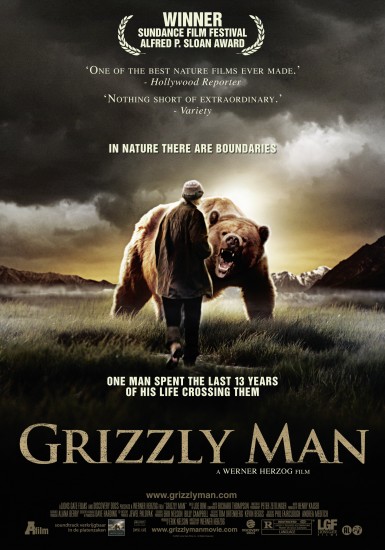
Grizzly Man


It is the third film by director Werner Herzog, that I saw. The earlier two (Aguirre and Fitzcarraldo) and this one, make me believe that the favorite theme of this director remains an enigmatic mix of wilderness, civilization, passion, obsession, life and death. To tell it more clearly - on the risk of being too definitive - his films remains a document of clash of wild and civilization (here both are equally brutal and murderous), the descent of passion into obsession, and the game of life and death (game of survival). And when we look more closely and read more about the director, these are his ways to understand people - and again to put it more definitively - to explore the darkness of human nature.

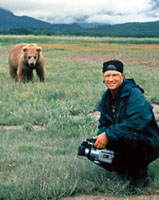
This film is a documentary about Timothy Treadwell, who lived with Grizzly Bears for 13 summers in Alaskan peninsula and on this last expedition (along with his girl friend Amie Huguenard), he was devoured by one of the bears. Its an irony of sorts at the first look. The man who came to save them was killed by them. But as the film progresses we came to know that its not that simpleton.

Most of the film is actually shot by Treadwell himself, who shot above 100 hrs of footage when he stayed with the wild bears. What Herzog did is to edit them, mix them with some interviews with Alaskan natives, geologists, officials and Treadwell's friends and provided an evocative narration. Herzog's voice is non-condescending either to the bears or to Treadwell, I found the narration superlative. Even when Herzog draws some conclusion and personal insights, we know that he is not giving a conclusion or general simplistic view. His commentary shows that he knows and respects the people and situation, he is dealing with.

Treadwell's courage and his obsessive desire to bond with the wild bears tells us as much about him as about the concepts of courage, bonding, communication and obsession. On Treadwell-ian scale, I am an extremely timid person. Also there is one more point that I am not sure of. Can courage accrue ? What are it limits ? One of my friends, who drives his bike at neck-break speeds says that he does not feel a bit scared doing that stunt. He says that this courage builds up. When asked whether he will try to test his limits, he replies, I don't drive alone, there are people on the road that can not cope up with my exploits. This is the whole point of being in a civilization, there are limits that you think you can cross but are not justifiable (the other way to look at it may be that he lacks courage). He goes to remote areas to drive like crazy, without knowing that it doesn't take two to kill, when you race a bike. Probably that why Treadwell resented civilization and spent so much time with the bears, and wanted to be like them. The point he probably missed is that wild is no better than civilization, in the end they are both same, and in the wild, although there are not written rules, nature rules. The delusional hope that he will bond to bears better than the human proved fatal for him. Treadwell knew bears were wild, film shows two male bears ferociously fight to court a female, and a baby bear is killed by his own father to stop the female to lactate so that the male can fornicate her. Treadwell accrued the courage to move nearer and nearer to the wild, but there was no such communication back from the wild, except in the mind of Treadwell. One point, from Treadwell perspective, is why he did that. The justification he gave for this is to protect the bears but reasons and justifications are seldom same. This documentary tries to explore some reason for the passion that turned to obsession, and gradually delves into his mind and psyche, which is both horrifying and compassionate.

At one point, Treadwell says "Everything about them is perfect". That sentence reminds me of people, who are quite amused by the nature and its beauty. This is not to deny the natural beauty but they loose the sight that beauty has its horrors, and we should respect both. Although not related to this post, I also don't understand what amusement people get when a natural place is turned into a luxury resorts. First they take a natural beauty, make it artificial and advertise and claim how near to nature it is. Do we all really have any desire to go near nature, but can not go near if its too natural, or its just another gimmick to make money and satisfy some residual unsatisfied desires. Its always fun to see how people call the others who come to such places as crowds. We belong to a funny species with some hollow sense of self-importance.

Coming back to the documentary, Herzog also brings two more very important characteristics of Treadwell and where as a filmmaker (and especially the one who has worked in wilderness and with the wild [I am referring to Kinski, no pun intended]), he could relate to him as a person shooting in the face of death and danger. Herzog discovers a filmmaker and an actor in Treadwell. There is a footage of Treadwell acting for himself with his camera on a tripod, where he acts in a film in which he plays some sort of forest ranger to protect bears from poachers. I think the absolute fantasy of an actor is to find someone who can write complex stories and he can act them. His fantasy is to charm everyone with his acting, and its sort of an obsession too. Treadwell made these tapes of himself with the wild bears and showed them to the world. For him, he was the person who wrote heroic parts for himself, the roles of a savior hero. All alone, away from civilization, he thought he was the hero. Also there is an intimacy in those films (especially where Treadwell goes to confessional mode). As a filmmaker, Treadwell compulsively shot in the wild and took some amazing footage of the wild nature, at times taking as much as 20 retakes for perfection. One of my favorite shots in films is where there is a background (think it as a lane where it is raining and no one is there, its evening), the actor comes, acts his/her part and goes away, leaving the empty background, camera stays there for a while. There are several such shots in films by Ozu. In one of the tapes, Treadwell do exactly the same. The background was thick forest with wild winds blowing, he comes to the frame, speaks his lines and leaves, and camera stays there looking at the trees and the wind that sways them, that Treadwell had left behind. I thought there is a certain beauty and a solid metaphor in that.

Although its a documentary and if there is a plot we know it beforehand (Treadwill will be killed by the bear), but like a narrative film, Herzog builds the character of Treadwill with small stokes and we go on adding bits to our cliched understanding of him as the film progresses. At one point of time where some persons reject Treadwell as a freak, Herzog speaks in the narration that he don't think so. But the whole effort was not to justify what Treadwell and all the people like him do and are doing, but its to understand them. To draw a distant analogy, we may think the Emma Bovary as selfish and petty woman but Flaubert tries to understand her in all her flaws and let his readers do that. Its not about whether the person is good or bad but its about to translate them to the audience and readers.

Read the Sensesofcinema profile of Werner Herzog here. Its added in the 41st issue.

Monday, April 14, 2014

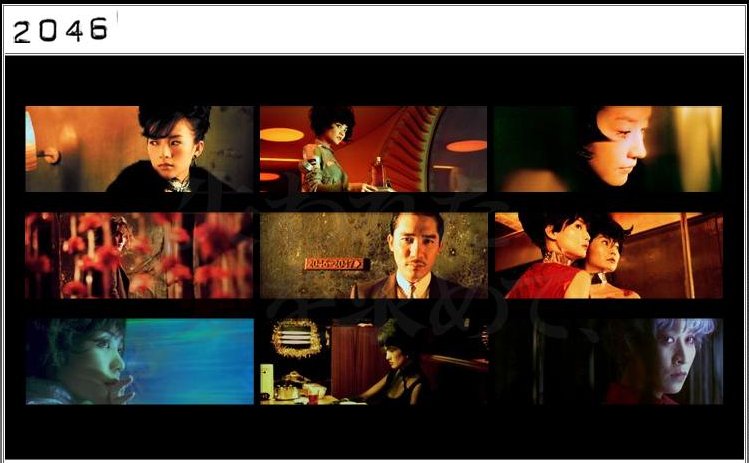
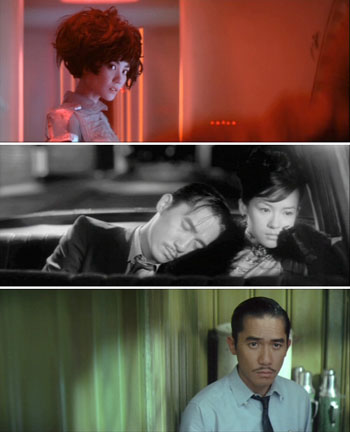
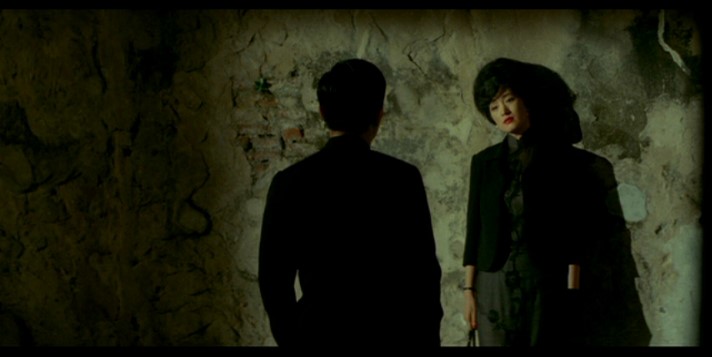
2046


Thanks to Alok, on Sunday evening, I saw 2046 on big screen. Although I was tired from two days of night out, I pushed myself to the screening so that I may go though the experience of visual and sound, two things which Wong Kar-wai seems master in fusing so well with each other, and thus creating the often talked about 'mood', which warrant a big screen viewing.

When I saw 2046 for the first time, I approached it with infinitely high hopes and as a continuation to Kar-wai's masterpiece In the Mood for Love. My first expectation was not fully fulfilled but it did wonders in being a continuation to In the Mood for Love. It had similar themes; it had its sublime moments of deep eroticism accentuated by great music and searching visual and most importantly the devastating power of unconsummated smoldering love.

The newspaper man (Chow Mo Wan, Tony Leung Chiu-wai reprises his character from IMFL) of In the Mood for Love has moved to Hong Kong, is writing erotic novels, lives in Hotel Oriental and now having a playboy sort of living, lots of one night stands, but is never able to get over the past. He comes in contact with three women and they are in one way or the other related to his past affair, an affair which is too deeply felt and too brutally truncated that he is not able to make any new connection, any new memories, always traveling on a train to reclaim his past memories, an effort that keeps him away from making new memories. But as the life goes, people come to your lives and the past rumbles up and down, although eventually you are lost in memories which are all about past, recent past and irrecoverable past. This ghost haunts our hero, in the hotel rooms and alleys, in the curves of women, in any contact he wants to make.

The thing that I most adore about Wong Kar-wai is his thin stories and how they come to life with flair and the mastery of cinematic medium. Wong Kar-wai is a master in making references to the past in the ways few can even attempt. The choice of symbols are too elegant, of all bigger things Kar-wai chooses the number of the hotel room to keep as a reference to the lost love. The material things of the consumer world gets the shape of love objects in his hands, whether its the tinned pineapples with a particular expiry date, or a 10 dollar bill paid at every visit to the lover, or the cards that are played between lovers, or the heaps of martial art books that the lovers exchange, or the fishes in a lover's apartment or the place where the lovers meet, the wall behind and the flicking bulb in a romantic rain. These all becomes the portals to the past; something very personal sticks to them. This concept is too thin to make any art out of it, but Kar-wai does it, and that too with such a style which somehow transport you to that lonesome town where all the lovers in Kar-wai movies reside, amidst the blazing neon lights and never stopping and chattering crowds.
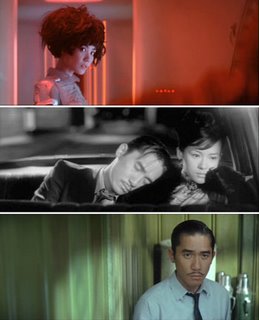

2046 has a bigger canvass than In the Mood for Love. The three stories are connected to IMFL beautifully. The story of a prostitute, Bai Ling (Ziyi Zhang), has the connection to the hotel room where the couple stayed in IMFL, The story of Wang Jing Wen (Faye Wong) is related to her common love for Kung-fu novels with the hero, who tried to write such novels with his lover in IMFL. The third story is about a mysterious gambler, Su Li Zhen (Gong Li), who has the same name as Chow's lover in IMFL (Maggie Cheung). And along with all this there is a futuristic tale of a train which people board to regain their lost memories, but they never come out of it. In all this meandering narrative and brilliant visual, Kar-wai tries hard to give his patent mood, mood of loss, mood of sexuality and mood of regret, mood of secrecy, sex and love.

An important quality of his movies is the way he blends music to visual. This mastery is even seen in the title sequence of 2046, as the array of Chinese letters flash and fade on screen, music come and goes, as if assisting their movement, matching their rhythm. I particularly like IMFL for this reason, the audio-visual treat that it offers, without losing the right note to synchronize camera to music, Su Li Zhen's every ascent and decent becomes an act of love, an act of art of love, her curves, looking back at stairs and her wiping off the rain drops from her forehead becomes such a profound experience that remains with you long after she has reached her small room and finished eating the noodles.

2046 lacked such a trance, at least in story of Li Bing, an oh-so-beautiful prostitute, who falls in love for our hero. Wong Kar-wai has a way with actors, which he seemed to have lost in one of the stories in 2046. Xiang Xiyi is so beautiful and I think a good actress too, but I think she didn't realize that in a War-kai movie you don't 'act' but just be. Her story, which is longest of all, has a touch of conventional acting which Kar-wai actors only show when they are in crowd but with their lovers they become all so muted, all too intense. All the talk and all the rough sex in this story can be muted, can be made more painful and so is the emotional/dramatic impart that Li Bing go though when the relationship does not work out. It becomes a sort of melodrama that we don't expect from Kar-wai. In a Kar-wai movie, tears don’t reach the chin, they are wiped out, with ruthless secrecy, on the cheeks itself. Here the tears reach the chin, several times.
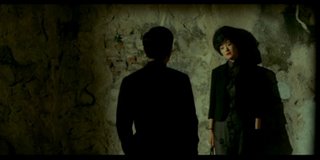

I loved the other two stories too much. The one with Faye Wong in love with a Japanese man, learning an alien language, and writing Kung-fu novels, and the painfully sad and deeply sexy story of a gambler, played by Gong Li, who is trapped in her memories, a female version of our hero. Both the actresses in these stories are exceptionally well. Faye Wong as a love-lorn teenager and a loving android, does such a magic that makes her lost Japanese love, ooze out of her emotionless android body. Gong Li gives a very mature performance with little dialogues and an extremely potent gait in the gloom of her hidden loss. After seeing Gong Li as Su Li Zhen, I thought she is even better than Maggie Cheung of IMFL, who missed a string or two in her performance. A small but extremely efficacious role of Su Li Zhen sizzles the screen with a powerful kiss towards the end, with melancholy music, red lipstick smeared out of the lips as if she just allowed herself to be raped by her present lover, with past carefully keeping a dreadful watch, she walking down the stairs like a fallen goddess.

The film also engages in a good old cliché, 'The Lonely Christmas Cliché', which could have been avoided given the past inventions of ennui by Kar-wai, all those beautiful inventions to refer to hole in the hearts of lovers that merge reality to fiction, producing a modern fantasy. There are some minor problems with editing which a casual watcher like me could also point out, but on a second thought I always question myself, was it meant to be like that, especially in case of masters of medium like Kar-wai, who don't care much for schedules or budget. One more problem with 2046 is its dialogues. As is the case with War-kai's stories, they are either so everyday that no mushy flamboyant communication will go with it, or they are so passionately intense that no communication in words is required at all. Characters will talk about ties and purses, but never about love and how they feel about it. 2046 has some notoriously naive dialogues which, at times, makes 2046 looks like a love child of IMFL and a mushy hallmark card.
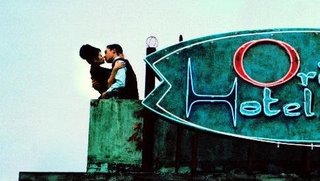

But I must say, there is no denying the fact that its a potent sequel to In the Mood of Love, it broadens its canvass, it takes further the similar themes adding the sublime theme of regret and it is as beautifully crafted as IMFL. 2046 opens the memories whispered in the tree hole, and we find out that the wound is still bleeding and Kar-wai captures all that gore and dressings with love and understanding. For me, who so loved IMFL, and somehow want to remain in that realm, in that train of past, 2046, with all its flaws, knocks me down at least in parts and will linger for long.