{Of all lies, art is the least untrue - Flaubert}


Wednesday, January 14, 2015

When a Woman Ascends the Stairs


The thing that I have always appreciated about Japanese films is what I call 'the acting of smiling faces', whatever emotional upheaval characters (especially women) go through, they smile and smile, although we are always aware that under this veneer of smile, there is a hidden sadness, hinted by subtle facial expressions (even at times hinted by actors turning away from camera, trying to get a moment of respite for the characters they play). Its a great metaphor of facade required for everyday life and obviously its stylistic cinematic interpretation may not be taken for general Japanese behavior but it does definitely hint to their culture in particular and human nature in general.

If I try to brief the plot of Mikio Naruse's When a Woman Ascends the Stairs, it will look like a run-of-the-mill melodrama - a tragic story of an epic, unfortunate heroine, misunderstood and unable to get true love, but Naruse's treatment has sensitivity and fluidity that makes a usual story become sublime and evocative document of hopelessness of a woman trapped like our heroine is.

In all its differences, I can't help but say that When a Woman Ascends the Stairs is a sister piece to Fellini's Nights of Cabiria. Obviously, Naruse's film is more interested in the scrutiny the post-war Japanese society and the place of women in it, unlike Fellini's heart-felt fascination for primarily one character - Cabiria - and her search for love, it plays more like the story of bar girls . Cabiria is looking for love, and fails, Naruse's heroine, Mama ( played by Naruse's regular Hideko Takamine), who works in a bar in Tokyo's Ginza district, is surrounded by potential suitors, has no dearth of love on the surface, but she too is a woman looking for love, and like Cabiria, unable to find it. Mama, unlike Cabiria, is not gullible and also unlike Cabiria, she is quite a standard character - a graceful polite experienced bar girl, aging and fearful, looking for a career along with love. Naruse's mastery - in part - lies in the fact that he makes such predictable character interesting. Naruse's movie also has the shadows of past, the war-torn economy booming, the economic divide, the so-called modern man caught in traditions and stereotypes, how surface boom and money didn’t translate to happiness in lives - all this serves as the harbinger of modern-urban ennui and alienation which has obsessed the minds and hearts of most modern film makers.

Also, the film is unmistakably a feminist work where heroine goes through all highs and lows, trying to survive by her own, the men around her provide occasional respite or drama but they are more or less extras to her story, and its feminist also in the way it shows that all the wars and progress made and staged by man (or our notion of masculinity) eventually has the toll on women, forcing them to gather a new life from debris every time. Along with Mama, we see several bar girls struck in maze of bars, trying to deal with it in their own ways. Unlike Nights of Cabiria, where the last scene celebrates the human spirit, the last scene of this film is undeniably the celebration (and at the same time crushing also) of the female spirit. Unlike Cabiria, Mama, doesn’t smile though tears, she just smiles the Japanese way, but we know they both mean the same.

Redacted

In Redacted, Brian De Palma dramatizes a real event - the rape and murder of a 14 year old girl in Iraq by five US soldiers. He constructs a base camp in Samarra with stereotypical soldiers, one of them read John O'Hara's 1934 novel "Appointment in Samarra" and the other reads Hustler, the wall behind them is covered with pin-up girls, they all look bored, one of them is photographing everybody else and as he adjusts his camera to shoot, he pompously proclaims "Truth is the first casualty of war".

The primary concern of De Palma has remained the point of view (I think the whole Snake Eyes is made to prove that a certain point of view has only a piece of truth, although there always exists a whole truth which eludes us just because we have the disadvantage of being at the wrong place at the wrong time. Here the hunger for truth is given. If it doesn’t exist, nothing, irrespective of our place or position, will register to us. That hunger may be called humanity in one sense, morality in other). Redacted starts with one point of view that is from the video camera of Angel Salazar (definitely a stand in for the director's own guilt of filming a crime as an act of intrusion and exploitation), who is making a video diary of his experiences. He even tells the viewer his directorial preferences - "I will tell what I see", "There will be no logical narrative to help make sense of it". He is essentially a voyeur and even opportunistic. Even when his fellowmen decided to rape the girl, he didn't stop them but accompanies them to shot the crime. As the film progresses this single point of view gets lost in several such POVs, there are many opinions, images and fragments of truth and lies. Brian de Palma, the master of irony, stores pure seriousness for special moments. There is a moment later in the film where an Iraq returned army man, weeps when he is supposed to smile and pose for a photograph with his wife. But this image too, doesn’t capture the whole truth, just some of it, and of course it’s posed.

As always, in our complex minds and lives, a lazy logic works that looks for the arbitration of our roles, shedding of responsibilities and cleaning off our souls. A little gush of impolite wind gives us all the reason in the world for our missions to save our souls. The young boys in Iraq are soldiers are with no reason to be there other than get orders, get a valid passport to become the part of mission whole heartedly when one of their buddies gets blown up. Now an unjustified war against a nation is translated to a personal war between us and them, a revenge of sorts. But the point to note is that both of them are victims, or to use title of De Palma's Vietnam film, "Casualties of War". The wrong-doers of Redacted don't show remorse, rather they try to cover up and justify what they have done, the remorse is shown by other colleagues due to their inability and disappointment to stop them doing the wrong (here crime and remorse are not hard coupled, they travel across consciences, so its not a zero sum game as in films like Munich where the guy weeps off his crimes towards the end to come out cleaner) and here De Palma daringly suggests that whole of America share this guilt and frustration.

De Palma's technique and filmmaking choices here are kind of double-edge swords. De Palma's use of mixed sources (websites, chats, you tube, French doc, surveillance cameras) and techniques (hand held cameras, HV video, improvised acting, imperfect shots) looks both amateurish like a school play and urgent like an activist's campaign on one side, and also an act of desperation to find truth and sort it into some coherent thread (which, we know, is a lost cause in De Palma’s world) on the other side. One should note that these choices are not ad hoc, but precise assortment of the crap and the credible, which, in today’s world, are becoming increasingly difficult to sort out.

There are many surface flaws (Bad acting is definitely not one of them, there are few very good performances especially from Patrick Carroll, who plays the hollow-eyed sinister, Reno Flake) in Redacted like the incoherent plot device (one of the soldier is shooting the war so that he can apply for film school), naive dialogues, over the top reportage, in your face long rants etc but these are De Palma's usual trademarks, especially of his earlier political films. In Hi, Mom! , De Niro's Jon Rubin, a Vietnam vet (there are references of Vietnam in Redacted too, when an angry girl on youtube rants "You don't see the My Lai Massacre in the movies, because the truths of that fascist orgy, are just too hellish for even liberal Hollywood to cop to. Oh, but that doesn't stop them from making another movie about 9/11, because an American life is worth so much more than a Vietnamese life, a Palestinian, a Lebanese or an Iraqi life because we are the uber race"), rents an dirty apartment in front of a big building to photograph women, and even sets up a date (the funniest date in films I have ever seen) so that he can make a film of them making love which he can sell to a producer of pornographic films. Things go little weird when Rubin gets involved with a group of activists doing some guerrilla theatre (the famous "Be Black, Baby" campaign, which is a must-see). Here too, stupid plot device, rants and naive dialogues are used but they are not used in a similar way as in Redacted. In Hi, Mom! (made about a decade and half after the war), things were in post-mortem state and therefore director has the luxury of irony, surrealism and even comedy. Hi, Mom! has the post-war insight and irony but Redacted has the present-war frustration, anger and polarization (Redacted is not balanced and that’s why the cry from all over that it will harm the troops). Here these surface flaws are the flaws of the sources that De Palma borrows from and it create a fractured fuzzy picture - gritty, crude, true but ultimately posed.

It should be noted that Redacted is nothing near De Palma's masterpieces like Hi, Mom!, Body Double, Blow Out and Femme Fatale, but it also not a low point in director's career. A director, who has always dealt with dreams and fantasy and in the illusion when they are mixed with reality and truth, is definitely not in his safe territory, but it is also important to note how he uses his primary visual and moral concerns in filmmaking to explore how the war is presented to us and how we are made to consume it.

The film ends with real pictures of killings in Iraq war (a segment named "Collateral Damage"), with a final fictional image of the dead girl, brutally raped, mouth open and lying in the pool of blood. This image placed along with real footage is again De Palma questioning about the truth of images. It’s most ironic and disturbing that a fabricated photo is more terrifying to us than the real ones. The beauty of De Palma's art is its ability to generate true empathy from a faked image.

Few words about the music. De Palma never misses a note. The end credits are totally silent, and Handel Sarabande is used evocatively, and only wherever it is totally necessary.

Tuesday, January 06, 2015

A Thin Blue Line

Errol Morris' A Thin Blue Line examines a case of shooting of a police officer in Dallas and the procedure followed to find the culprit. 28 years old Randall Adams, who was with a 16 year old kid, David Harris (who becomes the chief prosecution witness against Adams) in his blue comet, was convicted of murder of a Texas Police officer, while all the evidence pointed elsewhere. Made in a style of re-enactment of the crime scenes, although it seems outdated due to the flush of TV crime reports on similar lines, this documentary is a very honest effort, both in terms how justice suffers from self-interest and wishful thinking, and also how the procedures of justice are not about truth finding, but just finding something/someone and closing the case. The conviction of Randall Adams was overturned when after the release of the documentary.

Here is a very interesting interview with Errol Morris. He says few things about truth, and how physical truth is absolute. And how style doesn't guarantee any truth. And to me this observation seemed quite true

I looked at Rashomon about a month ago. I re-watched it, and much to my
surprise, Rashomon isn't Rashomon. Rashomon is not a movie about the
subjectivity of truth. That there's no objective truth, just subjective truth. A
truth for you, a truth for me. On the contrary, it's a movie about how everybody
sees the world differently. But the claim that everybody sees the world
differently, is not a claim that there's no reality. It's a different kind of
claim. What really surprised me on re-watching Rashomon is that you know what
really happened at the end. It's pretty damn clear. Kurosawa gives you the
pieces of evidence that allow you to figure out what really happened. So, it's
not what many people imagine it to be, but it is a very powerful story about
self-interest, about wishful thinking, about self-deception, about people
imagining scenarios at variance with the truth. And so I found Rashomon to be
far more interesting than I had remembered it. With an underlying theme very
much like The Thin Blue Line. Truth exists, but people have a vested interest in
not knowing it.

Here is definitely a bifurcation, between the types of truth - the physical and the more complex metaphysical(I don’t know, is it the correct term but I am talking about something more abstract like truth about love and truth about life). What I feel at this moment that most of the times the efforts to find a wrong doer on physiological terms results in some gross generalization of evil (with phrases like "all man are dormant portals of evil") and that in tern results in lot of everyday injustice. Like in this case, Randall was thought to be a evil doer because, according to the police, he showed no remorse (like one of the police officer says "He overacted his innocence"). At this point, I should also see that when David Harris accepted his crime, he too showed no remorse. Actually, he was even more rational and cool headed as he said that Randall would have been saved if he had a place to stay, a perfect logic, but without a trace of remorse. I mean, if its so vague then how can “lack of guilt and remorse” can be generalized as a symptom of a criminal mind. Harris David also says some more direct and ironical in this last interview. He says "Criminals always lie", and its ironical because he is one, and it is also ironical because whenever any interrogation of a potential convict happens, it is invariably assumed that the he is a criminal, so does it matter whatever he says. I think, evidence gathering is a balance between doubt and rationality. And then comes the people like forensic psychiatrist, Dr. James Grigson (who was called Mr. Death after having testified in more than 100 trials that resulted in death sentences, actually Morris went to Dallas to take his interview but stumbled on Randall Adams case, who was one of Dr, Death's victim), and his vague psychoanalysis of Randall and his proclamation that if left free, he will be grave danger to society. It looks jarring that these types of analysis take precedence to any physical evidence. Even Errol Morris goes on to show a blurred picture of Harris' troubled childhood. I know these things matter, but my question always remains, what should be given more priority in an investigation. And the most interesting of all is Emily Miller, whose testimony finally results in the conviction of Randall. Its the most frightening interview, you can see, where the face of Emily glows when she says that she always wanted to be a detective, or else wife of a detective, and she is so watchful that sees murders everywhere.

And this part of the Errol Morris' interview of also very insightful. Here he talks about the fine line between reality and fiction.

When Capote wrote In Cold Blood, he called it a non-fiction novel. I remember
when I was a little boy and In Cold Blood came out, I got very depressed,
because I would read these long, long conversations that he supposedly
remembered in their entirety. I thought: how can he do it? I need a tape
recorder. I can't remember when I'm talking to someone for 10 hours what they've
said verbatim. I just can't do it. I can't do it. I'd like to be able to do it,
but I can't. And here was Capote writing pages of this stuff. And I thought, I'm
never going to be able to do that, and I was right, I'm never going to be able
to do that. And of course the question is whether Capote was able to do it.
Whether he was just able to write extremely well about the conversations after
the fact. Whether he was making stuff up.

Thursday, December 25, 2014

3 Films by Altman


For those who like country music, this film might not serve their purpose, although it has several great songs, especially I'm Easy. Those who are interested in politics, this film may look rather glib. For those who want strong characters, they have nothing heroic to see here. Those who believe in free-form, here they go. Underneath the web of huge ensemble cast lies a beautifully free film. Nashville is free from the tight structure, conventional character studies and formal narrative. Nashville is a work of an artist with a camera wandering in Nashville (it may be some other place) and is allowed to film some of the public events and even allowed to flick some private moments. In the song I'm Easy, which is shot in a bar, the song is a public event but the look on faces of all the four enticed women is very personal. That's what Nashville is all about, the relation with celebrity and the public, the connection between stardom and politics, the obsession and the its influence, music and the business, culture and the capital. Altman said once that he views his films as a mural which he need to fill in and the picture that would emerge is even unknown to him beforehand. When different object on the mural with brush and touch, a picture might develop. Nashville, likewise, brings a picture of hopes of people, their dreams and crossed lives caught in propaganda, venal promises and intentions, an mosaic of minuscule images but pointing to something universal. The first song, Keep A'Goin, which is also performed in the last act turns into to a classic irony of the hopes amidst the confused state of affairs that Altman is trying to point out.
Trailer of the film here.

Gosford Park


The setting of the film might not be what Altman would have liked a lot (consider this setting vs the ensemble cast of Nashville and Shortcuts). There are clear demarcations and a very thin/formal interaction between the two classes, one upstairs and the other downstairs. But what must have intrigued Altman is the tension in both the halves, and the subtle similarities and differences between and within the both sides. Altman, master of deftly handling huge casts, must have wondered how the hell to deal with the English upper cast, in all their flair and whims (One of my friends says that he is in love English culture and etiquette, I think he should immediately see this film and if he still want to hold the wine glass in some pre-conceived Anglo-way, I must request Maggie Smith's remarkably vicious Constance Trentham to help him take a tour). As usual, the British cast is excellent both up and down the stairs. To ruthlessly enumerate plot points of the film, its a gathering for a shooting party, a murder and its investigation. The part beauty of the film lies in its satire of these events, flooded with witty dialogues and mannerisms. Given, its an Altman's film, the characters are not representative, they are quite unique and distinct, not to be - as they say - different, but because they are themselves, and also a part of world they inhibit. If we find glimpse of some stereotypes upstairs, its lot to say about those characters. The other part of beauty comes from what is sand witched between the plot of upper and lower crust, there is something bittersweet and humane embedded. The actions upstairs are so secret, nasty and manipulated that we look up for warmth downstairs, which at the face of it, is absent there too. Busy catering to their masters, and in fact known by their master's name downstairs, they are entrapped in the hierarchy as their masters. The young ones seems uneasy with this, but the old servants have mastered the art of servitude. Replying to "What about your life", a head housemaid quips, "Didn't you hear me? I'm the perfect servant; I have no life". As the film progresses, a bundle of secrets unfolds, we see a warmth seeping downstairs, while the upstairs is too busy being a bitch. Towards the end of the film, there is an amazing little scene between two old sisters, and such scenes are for actors (In recent films, other such scene that comes to my mind is from Kinsey done amazingly by Lynn Redgrave, she even says "Prof. Kinsey, You saved my life" and every word of it sounds true), no director can rescue them, if actors don't spark. Two amazing British actresses (Helen Mirren and Eileen Atkins), pull up such a restrained melodrama that it fills the screen with some sort of catharsis.
3 Women

Its a tale of 3 women as the title suggests, here goes what we can understand. Pinky (Sissy Spacek) wants to be what she thinks Millie (Shelley Duvall) is and she thinks that Millie is what Millie wants to be, but Millie is not what she wants to be, she wants to be someone from the women magazines, which she reads. Millie utterly fails but Pinky pulls it up in what they both want to be. Millie and Pinky live in same apartment and work in same resort and in fact have same names. Millie is near perfect in her attires and according to her, known for her dinner parties. Apart from these two women, there is one more, Willie (Janice Rule), who paints weird murals, is pregnant, and has beautiful dark eyes. Enigmatic part includes the skirt of Shelley Duvall which never fits in her yellow car, her Mrs. Dalloway-type ill-fated parties, look on her face when she sees parents of Pinky make love when their daughter lies in coma, the eerie twins at resort, the murals which Willie paints, the birth of a dead boy and that eldritch dream sequence. The way Millie walks around people has that die-hard mix of confidence, caring and caution, that is needed to be a good social-bee. The reason why she is not observing that no one listens to her or takes notice, does it bother her or she go on and on with her recital of recipes and that spooky 'Hi Tom' greetings to Tom, who is ever-coughing, just to avoid going out with her. May be, Millie is a dead person but not aware of it. The infatuation of Pinky with Millie ! She admires her perfection to P. Does she ever notice or take seriously, the indifference that other people show towards Millie or the way Millie go about talking to them fascinates her, the way she is trying hard to dis-alienate. Why is Willie painting those naked bodies, where oracular female form is tortured by the male form. Does her philanderer husband symbolise that cave-male, male from cowboy movie shooting his guns. Why does Willie puncture her ghostly painting with bullets and why no one ever talks to her and she to no one. Several such things occur repeated in the film just like a dream, and its a spiral of all-too-fast unexplained events, that the sleeper wants to get out from, just like a dream.


Unlike other filmmakers, Altman try to give an explanation of it all this mixing of identities and roles, but that does not look to be the point. The point is somewhere between what is perceivable and puzzling. Its is more than tempting to start defining films myriad symbols, but such temptations are fruitless and vain, they are more on the lines of what I understood than what the director wanted to do. Males in this film are either horny (Willie's husband), or indifferent (Pinkie's father) or Dead (Willie's son and possibly Willie's husband too), its a misandrist's dream come true, but Altman doesn't leave his women scotfree, they are shallow and obsessed and engaged in power plays, but at any given point, they are either more human or more interesting then their male counterparts.

Friday, November 14, 2014

The Boss Of It All


Most of the problems in the world arise due to the fact that everyone likes to be loved even if they are more or less horrible people, and everyone has his unique definition what it means to be loved. If we translate this to a corporate guy, his definition of being loved may well be the straightest one. He wants to be loved and held in high esteem and integrity even if he has to pose what he is not, which comes very close to the definition of being loved by a normal person too, just that a corporate person is bound to a corporation, and in a way detached to what he does. The basic problem that all of these smiling, smart and sophisticated corporate people face is to manage and rule and at the same get the love of their subject, make them feel cared when they are being used. We have faced and we have used the big management D, the deference, which in this case means the deference of the responsibility of anything bad to someone else. The only glitch in that is, eventually it goes to a physical person, and that person may not get the love, may not be in the pool of the loved ones, and in that case will be unhappy corporate boss, which is not at all an admirable situation. There is heaps of self-help for both the loved ones and the lovers in the corporate world, but eventually the loss of innocence of the lovers happen and they all get the bitter truth about the loved ones (as you can see we are here taking a sort of ideal situation, the sycophant-gene is altogether neglected, but that can be neglected as its always good for the boss, which is our main concern here). There should be a better solution; there should be a better and easy world for our bosses. The Boss of it all gives that fine solution.

The owner of a Danish IT firm, Ravn, has that terrific idea. He hires a failed actor Kristoffer to pose as a made-up "boss of it all", and makes him responsible for making all the sensitive decision of the company and finally the decision of selling the company to an anti-Dane Icelaner and firing all of the six company's founding members except Ravn. But this foolproof plan has a small but basic problem, the problem that hired actor also wants to be loved. For an actor, the act of getting love is to please by his performance, to get the attention, for a director, it is a approval that someone got jolt and kick by seeing his stuff, which makes him feel something, something similar to being loved. What can be more dangerous than an artist who wants to be loved?

Like other films by Lars von Trier, this film is also an irony, and he spares none (von Trier believes that a film should be like a stone in your shoe :)), just that this time the mood is lighter, the camera is more playful, there is more air to breathe. This breezy irony, plays with the intentions of viewers, as if director is improvising against it, and a comic voice over always keeps things in a light mood and its director's simple way to say that its just a film, and that too a comedy, a irrational one. Film in its goofy irrationality and absurd setting, also examines the relation between the actors, directors, camera and the related ethics. Like the philosophical fool of Dogville, the actor in this film is also director’s doppelganger in particular, and artists and intellectuals in general. As a good satire is only on oneself (otherwise its bitching or criticism, and that is why Altman's The Player is an excellent satire), a good comedy becomes true only if the better jokes are reserved for oneself. Film’s end in which an actor shows what he is good at, is a potent joke on the creative urge and the related admiration that might follow from the performance, because whether it is a corporate cow or a creative crow, its all about being loved.

Tuesday, November 11, 2014

Ordet


As we all know that there is a thin line between a great excellent film and a masterpiece. The thin line is that is transcendence, to use a cliché. It’s the line where the images coerce themselves into one whole and go beyond. We feel free. A film that makes us feel free is itself utterly independent and fearless, of the people who want to kill it with the censorship of the so called profane, or to neglect and ridicule the so called trivial and also those who want to limit it to the worship of so-called good, moral and "useful".

Ordet is so fiercely austere and heart rending. Not a film has moved so much as this one in long time, both emotionally and intellectually. The impact of few films is so deep and elemental that writing about them becomes a clumsy clichéd exercise. This film does not particularly try to express the human condition and expand the human conscious, the prime theme of the film is faith, but it’s not the half-boiled, half hearted faith, but a mad magical love. Since here, even faith has true passion, the things which we might have thought to be slight and stupid, become both lifelike and magical. I, myself, have wondered the way people "use" faith, as one of the way, not "the" way, which defies the very notion of it in spirit. We all have seen, and we all have been, sometime or the other, fearful of faith, but still use it as and when required (As the film patriarch Morten Borgen puts it "But I prayed only because it was worth trying.").

Ordet is a story of Morten Borgen, owner of Borgen farm, and his family of three sons, Johannes, Mikkel and Anders, and Mikkel's wife Inger. They are all dealing with their faiths. The link between them is Inger, who keeps the house alive. The film starts with the scene where each of the family member go out to search for Johannes, who has again ran out from home, thinking he is Jesus. Johannes, who according to Mikkel has gone mad not because of love, but because of Soren Kierkegaard, enters the leaves the frame like the wavering faith of the characters. The way he speaks is prophetic and terrifying. The most terrifying of all is the scene where Johannes sees the beam of headlights of departing car and envisions the death. It is also very excellent use of lighting as a thematic element. Mikkel has lost his faith totally, but according to Inger, he has faith because he is good at heart. Morten, played wonderfully with a mix of old snobbishness and aged wisdom by Henrik Malberg, is also having problem with faith, especially because his prayers for Johannes are going unanswered. Anders is in trouble because he is in love with the daughter of the tailor, who has a different faith.

The main difference between Ordet and films of Bergman, especially Winter Light, with which is frequently compared is essentially the difference between the one still looking for any possibility of faith (faith in faith) and the one who has looked and found nothing, and how to come in terms with it. Actually, it quite unfair to compare the two, in spite of the common theme, because although they seem to be on same continuous line, but it requires a "leap of faith" or a "retract to reason" to jump between the two. Ordet is exemplary in its refusal to reason and rationality because it doesn’t look premeditated. One more film, Ordet is often compared to, is Breaking the Waves, primarily due to its final sequence, but to me Breaking the Waves tryst with faith is like an ironical kiss, but in Dreyer's Ordet, it is a full carnal affair. [Spoilers Ahead] In one of the most striking end scenes ever, as Inger wakes up and passionately kisses Mikkel, we can see the line of Inger's saliva that sticks out from Mikkel's cheek, gloriously celebrating the bodily resurrection along with the soul, and hence when Inger speaks “Life.. Life”, it’s a sensual feeling, not particularly a spiritual one. [Spoilers End]

Dreyer's film is as much about the nature of and our relation with faith, as it is about the limitations of rationality. The vision of Dreyer, as it comes of the film is neither of a cynical nor of a devout. The film, in the end does comfort, but that comfort owes the great burden, the burden of pure and unflinching faith.

Monday, November 03, 2014

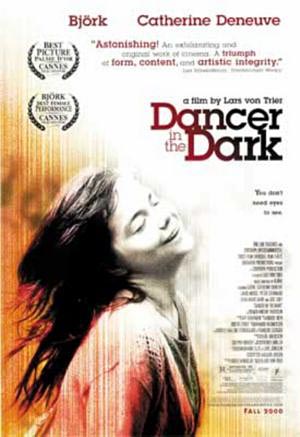
Dancer in the Dark.


Last night, I saw Lars von Trier's Dancer in the Dark. I am still confused which one I liked better, this or Breaking the Waves, I will see Breaking the Waves again soon. Dancer in the Dark has some very sublime moments. Its more emotional but less depressing than Breaking the Waves. I plan to write about it later in detail. For now see this video of the song titled 'I've seen it all' by recording star Björk, who stars as all-good Selma in the film, which is the part of the von Trier trilogy where the heroine remains innocent and saintly despite her actions.

In the DVD, we got to see two more versions of this song, one with longer cuts and the other one with very rapid cuts (especially towards the end). For me long shots work better. Also, this song is filmed using 100 cameras which are fixed at different spots and with few handheld cameras for close-ups and the quality of the later being better than the 100 digicams, was digitally distorted to match with that of digicam's. Lars von Trier talks in a documentary called '100 Cameras' that this experiment didn't work as they expected and explains why. Although this is not the best song of the movie in my opinion, but the most popular one and available online. I liked the 'next to last' song better, I need to see the film few more times to settle on my favorite though. I longed and longed for a song on 'Mum's the word', an idea which is so pivotal to the film as the basic motif of faith and goodness.

Wednesday, October 08, 2014

Titicut Follies


I read in a brief essay on John Houston's The Misfits by J.M. Coetzee , that the amazing thing about films is that the images that you see on screen actually existed in some time and space. He talks this not entirely from the perspective of actors who hold hands, kissed and sat together, but more from the perspective of horses who were supposedly ill treated in the film. I think he took horses as an example not because they are more animal than us in our worldview , but because they didn't know they are being filmed and thats why they never acted. Whatever is captured on screen is, nothing but, once-filmed-reality. The point I am trying to reach here is not the morality of such act (if that would be the case, Lars von Trier should be convicted first of all), but the immediacy, truthfulness of such imagery and the knowledge that it really happened at least once, which is at least one thing that the best of literature can't claim. This preciseness of imagery, to some extent, acts both as the power and powerlessness of cinema. And here we get the bifurcating thin line between films and documentary too. In The Misfits Marilyn Monroe was acting in a film but the horses were in a documentary, and thats why their pain looks more real and more harrowing.

Frederick Wiseman's Titicut Follies is a 1967 documentary about the treatment of patients/inmates at Bridgewater State Hospital in Bridgewater, Massachusetts. It was banned in US from 1967-1992 because it violated the patients' rights to privacy. It is widely considered an essential piece of work for its direct cinéma vérité style and the issues it raise.

Titicut Follies opens with a stage performance by inmates of Bridgewater State Hospital, in its stark black and white photography camera moves from one seemingly happy or blank face to other, who are performing some sort of chorus songs with props (Its like sad song sung by some happy or blank faces). The title of the film is taken from the title of this stage show. As it progresses, we meet other inmates of the hospital. We try to find whats wrong with them and invariably find out that they are either too happy or too sad or too talky or too silent by "normal" standards.

In the middle of Titicut Follies, a naked old man dance thumping his feet in his "prison" cell, I felt almost ashamed of watching something that personal, which is not owing to the nudity, but because it has really happened and it is an honest expression of a person's illness. We fear that someone might enjoy it, laugh at it or someone can even generalize this behavior to madness. Titicut Follies treads in such delicate terrain, that raises it moral responsibility. One of the important properties of sincere documentaries is that they don't comment/remark themselves, they show what they saw without rigging the moral fulcrum. Titicut Follies does the same and hence it comes out clean as an honest document, not just any biased or illiterate humanistic propaganda.

Titicut Follies is not recommended to all (If you wish to ignore, read its tagline first!), many a times in this documentary, one involuntarily takes his eyes off the screen, and even start questioning about its awkwardness, but the strongest point that Titicut Follies raises is the nature of mental illness (one patient, who was supposedly suffering from paranoid schizophrenia and was asking for his release, was so logically persuasive and questioning that you feel jarred) and even more importantly the nature of such institutions, even though it doesn't portray such institution in any bad made-up light. They are doing their job (which in some ways inherently includes indifference, gentle ragging and bullying/forcing too [there is a scene where an inmate is force-fed, this scene is inter-cut with the scenes where other inmate is laid out for burial and we feel some comfort while watching the later]), there are no evil, sadistic wardens. We know, Wiseman is honest enough to show the better and lets you ask for yourself, is it any good.

Thursday, September 11, 2014

Godard's Weekend


In fact, after watching Contempt, I thought of Godard as an academic film maker, not a film maker of ideas. Contempt remains one of the most bizarre films that I watched last year, if we look at the cinematic style, which is not brilliant because it makes a style of its own, as several fine films do, but it breaks down the conventions of film making which we usually accept as rules, thus helping us to see film making in parts, as a brick work of those raw materials. Contempt breaks several existing rules in the book and it tells us that there is no limit to creativity and visual imagination - the imagination in mixing the moving images, the sound and the ideas and the worldviews. Contempt has all what one will expect from a film maker who is known to break into and jump over fences. But Contempt should not be Godard's introductory film, as it was in my case. Its like an infant meets enfant terrible. Kid cries and listens to commentary track. I think what Contempt lacks is the flow of ideas. Although there is Brecht peeking in every frame but that alienation is not used to give us thoughts which Brecht talked about. Contempt has all the masters tricks but does not have much use apart from their display. The commentary track tells us about all those esoteric references and all those rules that are broken in front of our eyes but a normal viewer will think why they are broken, where is that greater good that is achieved by breaking them. I am undoubtedly confused when I saw Contempt. And yesterday that doubt is cleared when I saw Weekend, a film by Jean-Luc Godard.


A couple makes a mysterious plan to inherit the money from their parents and they leave their home to accomplish the mission. After some time, the questions like whether they will succeed and who will get the money (The couple even plots to murder the each other after getting the money and each of them have lovers, they are all in all bad people, but they are not some one off case, they are caricature, metaphorical and representative) and the whole narrative thrust of "what will happen next" becomes so insignificant that only the couple thinks about it but the film takes it own course. Its funny to see film not going where the main characters will like it to go. The film is denying them any heroic or anti-heroic significance. There is not much to talk about what happens in this film, but there is lot to talk about how it happens and how the expectations of the viewers are crushed again and again, and what he gets is, as one early inter-title says, a film adrift in cosmos. It may look as if different parts of this film are scattered but as the film progresses, it takes a shape of ideas that the film wants to convey. Distancing the viewer from what is shown on screen to what director wants to say. The film is polemic and very direct in that way. We hear monologues on Marxism and Maoism (which is criticised by some critics as didactic and over the top), and we hear French revolutionary Saint, narrate us the ideas of liberty.

In a delicate episode, a piano player remarks something that is so profound. He says about Mozart, "Mozart is too easy for beginners and children, too difficult for virtuoso". These types of episodes are particularly dear in the way they are crafted, free and without any text book format, camera pans leisurely to show people standing and sitting as the piano man plays Mozart, the way it is placed next to the car-chaos of cities and highways. Mozart music relates to the serenity of the place. The look on the faces of the village people listening to music and the couple, as insensible as they are shown, could not care less and look immensely bored by it. They want to move on, and the director wants to show another such episode. Beautiful conflict, that Godard uses to bring across his idea of industrial imperialism and bourgeoisie sham, to name a few. All those time tested plot tactics of sex, murder and deceit, that Godard show in the beginning, lead us nowhere, and Godard takes us to an absurdist journey hopping into bourgeoisie, Marx, slapstick, satire, literature, philosophy, civilization, class society, music, pop art, parody, politics, activism and cannibalism.


Cinematic conventions are twisted in each frame. The sound and image are almost always incoherent. The background score becomes gloomy, it heightens and it dissolves for apparently no purpose. There are inessential details, like the time, its Saturday - 10 am, another five minutes have past, the kms in the speedometer etc, as if viewer will want to keep track of it. It has the shadows of commercialization everywhere, and cars becoming a big symbol of it. Anything that uses oil and moves is ridiculed by Godard, including humans. The very famous, 8 min tracking shot of a traffic jam shows us a view of Parisian life, blood, dead bodies, animals, daily life conflicts and different sizes of cars. In an accident, a lady screams that she has lost her designer purse, in a very interesting episode, the lead couple burns Emily Brontë because she is not giving answer to their question, in the same scene, Brontë asks them GMAT type questions. The discussion between a young rich girl and a tractor driver is directly out of Communist manifesto's first chapter, the Bourgeoisie and the Proletarian. Towards the end, the hilarious orgy which was narrated earlier in the film (see the narration of this orgy scene in contrast to that of Bergman's Persona), is actually performed, but in a very unexpected and hellish way, and the film moves from bourgeois houses to countryside to guerrilla jungles and amidst all this chaos, Godard's version the living hell emerges. Unlike Contempt, this film fills those detachment gaps with solid ideas and radical thoughts.

For me, this film became a unique experience. After watching Weekend, I rushed to see Munich, and it is such a contrast in approach, although its unfair to compare both, but you cant help it when you watch them back to back. Weekend looked like a 'View source' of Munich's pretty HTML page, to put it in a slapstick way. I have starting feeling contempt for all those high risk saving scenes (the one where the Arab ambassador's daughter was saved in Munich) after watching Funny Games and Code Unknown (there is similar scene in Code unknown where a toddler is saved while his parents frolic in swimming pool, that scene has an ultimate concoction of sex, skin show, family love, hyped excitement, hope and happy ending). Munich manufactured everything in detail while Weekend deconstructed every detail. Munich used emotions to take its point across and Weekend used mechanical monologues and chaotic imagery. In Munich, every act of violence is regretted with heroic closeups, in Weekend, there is no remorse when the rabbit of Monsieur Flaubert is killed. Before sleeping, I gathered what was Munich all about while traffic cars honked endlessly, a cyclist thrown off pavement by a honking car, car ran down by big truck and so on.
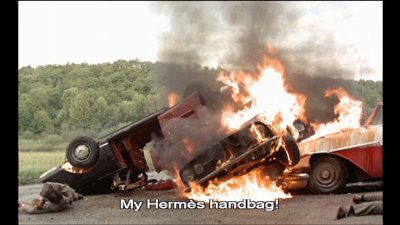


Weekend took a step further in what I thought movies like Code Unknown can do. Code Unknown episodes have reality, they are even emotional. But Weekend, at times, looks unreal, but like a near future of our civilisation - its end, it horrifies and jolts. Weekend is unapologetic in being prophetic. Weekend is meant to irritate and to frustrate, it may look insane to people, it is actually a caustic, mean film, grotesque, as some may say "what the hell is going on". It is all that and more. It is angry and aggressive. Some people will hate it and I think that's what director wanted. Its not easily ignorable, as a bunch of undeniable ideas, as the view of urban hell, and also to know cinema as an art form of infinite possibilities